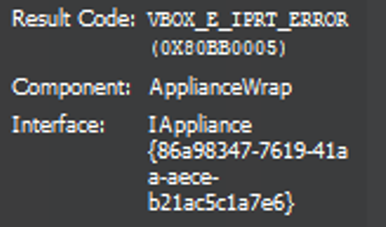
ova export not functional
-
@gasky thansk, I sent you an email
-
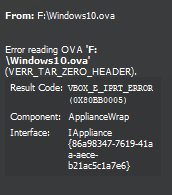
With ova from you I get the error
Edit:
The problem with ova is only on windows export, with linux export all is ok. -
@gasky
Does a xva export and then import works ? If yes could you give me the xva corresponding to this ova ? -
Hi, thanks again for your help.
So I have also tried using the OVA with a Ubuntu machine and had the same error (I have uploaded that OVA file to the drive folder).
I did what you suggested with the XVA file and yes it successfully exported (with compression disabled - the only one I tried) and then imported back into another instance of XCP-ng. I have included the XVA file in the drive folder also.
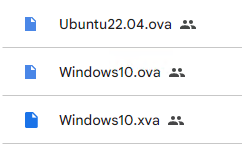
I hope this helps to get to the root cause of the error.
Thanks,
-
@gasky that is a good thing that the xva export / import works : this probbaly a bug in the OVA export, not on the XCP side or a problem on your storage
I am downloading the image right now and will look for a solution
-
I have the same thing with OVA of windows VM, on linux VM all is ok.
Import is done on VirtualBox 7 -
-
Linux, yes. Windows has by default 15Gb+, maybe core one has less
EDIT:
Windows 2022 Core, it works
Size on VHD,

Rocky Linux 9, it works
Size on VHD

-
Sorry, I don't have any VMs that small. But if I understand correctly from @Gheppy it seems the issue is related to the VMs size?
-
It might be this. @florent is the opportunity to make them test your branch

-
@olivierlambert yes, as soon as my branch is working as intended
For now I can generate a valid tar (with pax header) , but virtual box don't like it
-
could you try this branch : fix_re_re_ova_export (PR is https://github.com/vatesfr/xen-orchestra/pull/7183/files ) ?
don't forget to do a yarn install before relaunching xo, since we updated a dependency
-
Windows 22h2 ova is exported fine. The import goes to the end only if:
- it is not set to EFI boot by default
- the type of Operating System is on Other and the version is Other/Unknown
- video is under 16Mb
Linux ova export is fine. The import goes to the end with the same missconfiguration.
After the settings are done everything works fine.
Size of ova

-
@Gheppy yes
at least if fixes import \o/
I am creatig card in the backlog to improve the import. Could you extract the ovf file of the windows ova ( rename it to tar and extract it) , and send it to me or post in in the forum ( it should not contains any confidential information )
-
this is the metadata.ovf
<?xml version="1.0" encoding="UTF-8"?> <!--Generated by Xen Orchestra--> <ovf:Envelope xmlns="http://schemas.dmtf.org/ovf/envelope/1" xmlns:ovf="http://schemas.dmtf.org/ovf/envelope/1" xmlns:rasd="http://schemas.dmtf.org/wbem/wscim/1/cim-schema/2/CIM_ResourceAllocationSettingData" xmlns:vssd="http://schemas.dmtf.org/wbem/wscim/1/cim-schema/2/CIM_VirtualSystemSettingData"> <References> <File ovf:href="w10-22h2_sda.vmdk" ovf:id="file1"/> </References> <DiskSection> <Info>Virtual disk information</Info> <Disk ovf:capacity="51200" ovf:capacityAllocationUnits="byte * 2^20" ovf:diskId="vmdisk1" ovf:fileRef="file1" ovf:format="http://www.vmware.com/interfaces/specifications/vmdk.html#streamOptimized" /> </DiskSection> <NetworkSection> <Info>The list of logical networks</Info> <Network ovf:name="LAN0-1Gb"/> </NetworkSection> <VirtualSystem ovf:id="w10-22h2"> <Info>A virtual machine</Info> <Name>w10-22h2</Name> <OperatingSystemSection ovf:id="1"> <Info>The kind of installed guest operating system</Info> </OperatingSystemSection> <VirtualHardwareSection> <Info>Virtual hardware requirements</Info> <System> <vssd:ElementName>Virtual Hardware Family</vssd:ElementName> <vssd:InstanceID>0</vssd:InstanceID> <vssd:VirtualSystemIdentifier>w10-22h2</vssd:VirtualSystemIdentifier> <vssd:VirtualSystemType>vmx-11</vssd:VirtualSystemType> </System> <Item> <rasd:AllocationUnits>hertz * 10^6</rasd:AllocationUnits> <rasd:Description>Number of Virtual CPUs</rasd:Description> <rasd:ElementName>4 virtual CPU(s)</rasd:ElementName> <rasd:InstanceID>1</rasd:InstanceID> <rasd:ResourceType>3</rasd:ResourceType> <rasd:VirtualQuantity>4</rasd:VirtualQuantity> </Item> <Item> <rasd:AllocationUnits>byte * 2^20</rasd:AllocationUnits> <rasd:Description>Memory Size</rasd:Description> <rasd:ElementName>4096MB of memory</rasd:ElementName> <rasd:InstanceID>2</rasd:InstanceID> <rasd:ResourceType>4</rasd:ResourceType> <rasd:VirtualQuantity>4096</rasd:VirtualQuantity> </Item> <Item> <rasd:Address>0</rasd:Address> <rasd:Description>IDE Controller</rasd:Description> <rasd:ElementName>VirtualIDEController 0</rasd:ElementName> <rasd:InstanceID>4</rasd:InstanceID> <rasd:ResourceType>5</rasd:ResourceType> </Item> <Item ovf:required="false"> <rasd:AutomaticAllocation>false</rasd:AutomaticAllocation> <rasd:ElementName>VirtualVideoCard</rasd:ElementName> <rasd:InstanceID>5</rasd:InstanceID> <rasd:ResourceType>24</rasd:ResourceType> </Item> <Item> <rasd:AddressOnParent>0</rasd:AddressOnParent> <rasd:ElementName>Hard Disk 1</rasd:ElementName> <rasd:HostResource>ovf:/disk/vmdisk1</rasd:HostResource> <rasd:InstanceID>vmdisk1</rasd:InstanceID> <rasd:Parent>4</rasd:Parent> <rasd:ResourceType>17</rasd:ResourceType> </Item> <Item> <rasd:AddressOnParent>0</rasd:AddressOnParent> <rasd:AutomaticAllocation>true</rasd:AutomaticAllocation> <rasd:Connection>LAN0-1Gb</rasd:Connection> <rasd:Description>PCNet32 ethernet adapter on "LAN0-1Gb"</rasd:Description> <rasd:ElementName>Connection to LAN0-1Gb</rasd:ElementName> <rasd:InstanceID>nic0</rasd:InstanceID> <rasd:ResourceSubType>PCNet32</rasd:ResourceSubType> <rasd:ResourceType>10</rasd:ResourceType> </Item> </VirtualHardwareSection> <AnnotationSection ovf:required="false"> <Info>A human-readable annotation</Info> <Annotation>w10-22h2</Annotation> </AnnotationSection> </VirtualSystem> </ovf:Envelope> -
@Gheppy could you get us an ovf file generated by vmware ?
it would help us find the right fields to use -
I don't use VMWare but if you give me some time ( one day ) I will install a server with ESXI and I will do an export.
-
@Gheppy said in ova export not functional:
I don't use VMWare but if you give me some time ( one day ) I will install a server with ESXI and I will do an export.
no worries I 've got one in my lab, I will just have to create the VM
-
@Gheppy
found it , it's the keys for UEFI<vmw:Config ovf:required="false" vmw:key="firmware" vmw:value="efi"/> <vmw:Config ovf:required="false" vmw:key="powerOpInfo.standbyAction" vmw:value="checkpoint"/>and there is for the video card
      <Item ovf:required="false">
                <rasd:AutomaticAllocation>false</rasd:AutomaticAllocation>
                <rasd:ElementName>VirtualVideoCard</rasd:ElementName>
                <rasd:InstanceID>8</rasd:InstanceID>
                <rasd:ResourceType>24</rasd:ResourceType>
                <vmw:Config ovf:required="false" vmw:key="useAutoDetect" vmw:value="true"/>
                <vmw:Config ovf:required="false" vmw:key="videoRamSizeInKB" vmw:value="16384"/>
                <vmw:Config ovf:required="false" vmw:key="enable3DSupport" vmw:value="false"/>
                <vmw:Config ovf:required="false" vmw:key="use3dRenderer" vmw:value="automatic"/>
                <vmw:Config ovf:required="false" vmw:key="graphicsMemorySizeInKB" vmw:value="262144"/>
                <vmw:CoresPerSocket ovf:required="false">1</vmw:CoresPerSocket>
              </Item>
we should be able to parse them ( from a virtual box/ esxi export) and add them in XO export
-
I am glad for this.
Is it published in git?
I will want to test it .
.



Hello! It looks like you're interested in this conversation, but you don't have an account yet.
Getting fed up of having to scroll through the same posts each visit? When you register for an account, you'll always come back to exactly where you were before, and choose to be notified of new replies (either via email, or push notification). You'll also be able to save bookmarks and upvote posts to show your appreciation to other community members.
With your input, this post could be even better 💗
Register Login