XCP-ng
    • Categories
    • Recent
    • Tags
    • Popular
    • Users
    • Groups
    • Register
    • Login

    Migrating an offline VM disk between two local SRs is slow

    Scheduled Pinned Locked Moved Unsolved Xen Orchestra
    34 Posts 10 Posters 8.8k Views 10 Watching
    Loading More Posts
    • Oldest to Newest
    • Newest to Oldest
    • Most Votes
    Reply
    • Reply as topic
    Log in to reply
    This topic has been deleted. Only users with topic management privileges can see it.
    • ForzaF
      Forza @DustinB
      last edited by Forza

      @DustinB said in Migrating an offline VM disk between two local SRs is slow:

      Separate question, why are you opting to use RAID 0, purely for the performance gain?

      Yes, performance for bulk/temp data stuff.

      1 Reply Last reply
      Reply Quote 0
      • ForzaF
        Forza @olivierlambert
        last edited by

        @olivierlambert said in Migrating an offline VM disk between two local SRs is slow:

        80/100MiB/s for one storage migration is already pretty decent. You might go faster by migrating more disks at once.

        I'm not sure to understand what difference are you referring too? It's always has been in that ballpark, per disk.

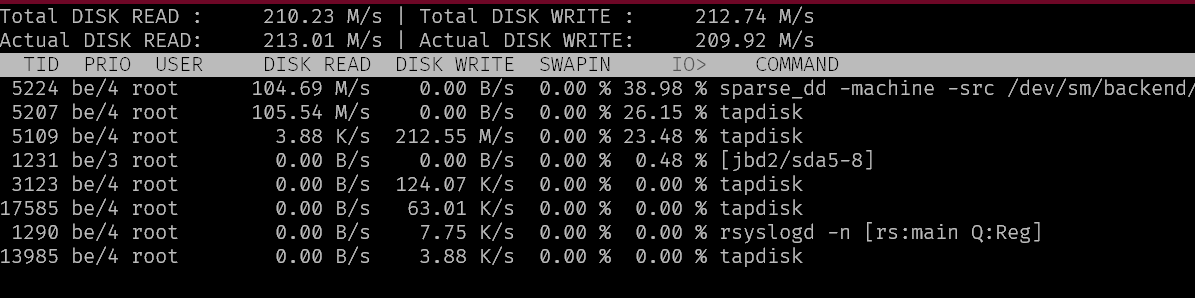
        This is not over a Network, only between local ext4 SRs on the same server. I tried the same migration using XCP-ng center and it is at the moment double as fast:
        bdde4643-4733-43ca-b685-560e0b54b02e-image.png

        Can't really see any difference though. It is the same sparse_dd and nbd connection 🤷 Perhaps it's a fragmentation issue. Though, doing a copy of the same VHD file gives close to 500MB/s.

        1 Reply Last reply
        Reply Quote 0
        • pkgwP
          pkgw
          last edited by

          What generally limits the migration speed? My installation is seeing a phenomenon that might be similar — when migrating between SRs we're only getting about 20 MB/s, while everything is wired together with 10 Gbps links.

          1 Reply Last reply
          Reply Quote 0
          • olivierlambertO
            olivierlambert Vates 🪐 Co-Founder CEO
            last edited by

            20 MiB/s is rather slow, are you migrating one disk per one disk?

            pkgwP 1 Reply Last reply
            Reply Quote 0
            • pkgwP
              pkgw @olivierlambert
              last edited by

              @olivierlambert No, this is an array of SSDs on a PowerVault, and we have evidence that the raw thoughput that we can get out of the system is much, much higher. I'm not 100% sure, but it seems that some software aspect of the migration framework is really bottlenecking things, although I've poked around and don't see anything that appears to be CPU-bound either.

              1 Reply Last reply
              Reply Quote 0
              • olivierlambertO
                olivierlambert Vates 🪐 Co-Founder CEO
                last edited by

                I meant one virtual disk per one virtual disk. If you migrate more VMs/disks at once, you should see it scaling.

                pkgwP 1 Reply Last reply
                Reply Quote 0
                • pkgwP
                  pkgw @olivierlambert
                  last edited by pkgw

                  @olivierlambert Ah, yes, that is true. We are migrating one extremely large VM, so there isn't much to parallize for us, unfortunately. But it is true that someone tried something that caused the system to migrate two disks at once, and the total throughput did double.

                  (Specifics: the machine is 4 TiB spread across 2 big disks and 1 small OS disk, and the way that we're attempting to migrate right now it all goes serially, so the task is taking multiple days and hitting various timeouts. We think we can solve the timeouts, and we don't expect to need to do this kind of migration at all frequently, but I'd still like to understand why the single-disk throughput is so much lower than what we believe the hardware is capable of.)

                  1 Reply Last reply
                  Reply Quote 0
                  • olivierlambertO
                    olivierlambert Vates 🪐 Co-Founder CEO
                    last edited by olivierlambert

                    Mostly CPU bound (single disk migration isn't multithreaded). Higher your CPU frequency, faster the migration.

                    pkgwP D 2 Replies Last reply
                    Reply Quote 0
                    • pkgwP
                      pkgw @olivierlambert
                      last edited by pkgw

                      @olivierlambert Thanks, that's good to know. I appreciate your taking the time to discuss. I don't suppose there are any settings we can fiddle with that would speed up the single-disk scenario? Or some workaround approach that might get closer to the hardware's native speed? (In one experiment, someone did something that caused the system to transfer the OS disk with the log message "Cloning VDI" rather than "Creating a blank remote VDI", and the effective throughput was higher by a factor of 20 ...)

                      1 Reply Last reply
                      Reply Quote 0
                      • olivierlambertO
                        olivierlambert Vates 🪐 Co-Founder CEO
                        last edited by olivierlambert

                        Can you describe exactly the steps that were done so we can double check/compare and understand the why?

                        edit: also, are you comparing a live migration vs an offline copy? It's very different, since in live you have to replicate the blocks while the VM on top is running.

                        pkgwP 1 Reply Last reply
                        Reply Quote 0
                        • pkgwP
                          pkgw @olivierlambert
                          last edited by

                          @olivierlambert This is all offline. Unfortunately I can't describe exactly what was done, since someone else was doing the work and they were trying a bunch of different things all in a row. I suspect that the apparently fast migration is a red herring (maybe a previous attempt left a copy of the disk on the destination SR, and the system noticed that and avoided the actual I/O?) but if there turned out to be a magical fast path, I wouldn't complain!

                          1 Reply Last reply
                          Reply Quote 0
                          • olivierlambertO
                            olivierlambert Vates 🪐 Co-Founder CEO
                            last edited by

                            You can also try warm migration, which can go a lot faster.

                            ForzaF 1 Reply Last reply
                            Reply Quote 1
                            • ForzaF
                              Forza @olivierlambert
                              last edited by Forza

                              Using XOA "Disaster Recovery" backup method can be a lot faster than normal offline migration.

                              One time I did it, it took approx 10 minutes instead of 2 hours...

                              M 1 Reply Last reply
                              Reply Quote 0
                              • M
                                magicker @Forza
                                last edited by

                                I think I am seeing a similar issue. Raid1 NVME copy to raid 10 4x2tb HDD on same host

                                a 300gb transfer is estimated at 7 hours. (11% done in 50 mins)

                                the vm is live.

                                according to the stats almost nothing is happening on this server or the 2 storage

                                1 Reply Last reply
                                Reply Quote 1
                                • D
                                  Davidj 0 @olivierlambert
                                  last edited by

                                  @olivierlambert
                                  Is the CPU on the sending host or the receiving host the limiting factor for single disk migrations?

                                  M 1 Reply Last reply
                                  Reply Quote 0
                                  • olivierlambertO
                                    olivierlambert Vates 🪐 Co-Founder CEO
                                    last edited by

                                    I can't really tell, gut feeling is the sending host, but I have no numbers to confirm.

                                    1 Reply Last reply
                                    Reply Quote 0
                                    • M
                                      magicker @Davidj 0
                                      last edited by magicker

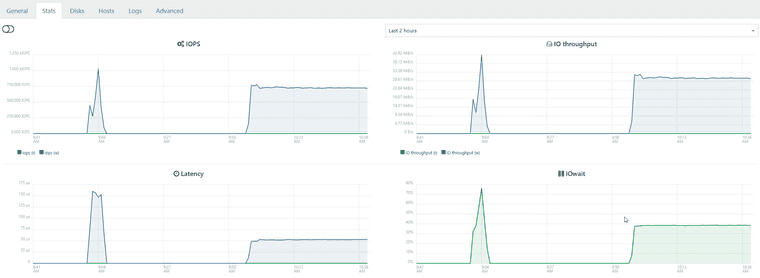
                                      @Davidj-0 in my case there CPU activity is minimal. I think something is wrong with the software raid 10 setup. On an identical setup warm migration between to the raid 10 array between hosts is showing horrible iowait similar to the sr to sr transfer on the other host
                                      bb40264a-7678-4906-aca5-788bc217c7f4-image.png

                                      1 Reply Last reply
                                      Reply Quote 0
                                      • olivierlambertO
                                        olivierlambert Vates 🪐 Co-Founder CEO
                                        last edited by

                                        Maybe the IO scheduler is not the right one?

                                        T 1 Reply Last reply
                                        Reply Quote 0
                                        • T
                                          tosh @olivierlambert
                                          last edited by

                                          @olivierlambert
                                          I think I found the root cause of the slow Storage Migration performance I reported above.

                                          After tracing sparse_dd, the issue appears to be an interaction between Nagle's algorithm and TCP delayed ACKs on the NBD connection.

                                          With strace, I found that sparse_dd sends the NBD request header and payload using separate write() calls:

                                          write(fd, <NBD header>, 28) = 28
                                          write(fd, <data>, 2097152) = 2097152
                                          read(fd, <NBD reply>, 16) = 16
                                          

                                          Normally this is fast, but there are also periodic 512-byte requests:

                                          write(fd, <NBD header>, 28) = 28
                                          write(fd, <data>, 512) = 512
                                          
                                          ~40 ms delay
                                          
                                          read(fd, <NBD reply>, 16) = 16
                                          

                                          During these stalls, ss -tinp showed:

                                          ato:40
                                          unacked:1
                                          notsent:512
                                          

                                          This seems to produce the following sequence:

                                          1. The 28-byte NBD header is sent.
                                          2. It remains unacknowledged.
                                          3. The following 512-byte payload is queued.
                                          4. Nagle's algorithm prevents that small payload from being sent while the previous data is unacknowledged.
                                          5. The peer's delayed ACK timer expires after approximately 40 ms.
                                          6. The ACK arrives and the 512-byte payload is finally transmitted.

                                          I also checked a packet capture. The destination iSCSI write only occurred after this delay, so the storage itself was not causing the 40 ms stall.

                                          To verify this before modifying the package, I attached GDB to the running sparse_dd process and enabled TCP_NODELAY with setsockopt() on its existing TCP socket.

                                          The effect was immediate: the notsent:512 stalls disappeared and migration throughput increased substantially.

                                          I then patched ocaml/vhd-tool/src/impl.ml.

                                          The current code is:

                                          let socket sockaddr =
                                            let family =
                                              match sockaddr with
                                              | Lwt_unix.ADDR_INET (addr, port) ->
                                                  Unix.domain_of_sockaddr (Lwt_unix.ADDR_INET (addr, port))
                                              | Lwt_unix.ADDR_UNIX _ ->
                                                  Unix.PF_UNIX
                                            in
                                            Lwt_unix.socket family Unix.SOCK_STREAM 0
                                          

                                          I changed it to enable TCP_NODELAY for TCP sockets:

                                          --- a/ocaml/vhd-tool/src/impl.ml
                                          +++ b/ocaml/vhd-tool/src/impl.ml
                                          @@
                                          -  Lwt_unix.socket family Unix.SOCK_STREAM 0
                                          +  let sock = Lwt_unix.socket family Unix.SOCK_STREAM 0 in
                                          +  ( match sockaddr with
                                          +  | Lwt_unix.ADDR_INET _ ->
                                          +      Lwt_unix.setsockopt sock Unix.TCP_NODELAY true
                                          +  | Lwt_unix.ADDR_UNIX _ ->
                                          +      ()
                                          +  ) ;
                                          +  sock
                                          

                                          I rebuilt vhd-tool for XCP-ng 8.3 and tested Storage Migration again.

                                          Before the patch, I was consistently seeing only around:

                                          30-40 MB/s
                                          

                                          After enabling TCP_NODELAY, I am seeing roughly:

                                          150-300 MB/s
                                          

                                          depending on storage activity.

                                          For example, during one test:

                                          eth2: ~174 MB/s
                                          eth3: ~174 MB/s
                                          lo:   ~320 MB/s
                                          

                                          and there were also physical-interface peaks around 300 MB/s.

                                          After the patch, ss still shows ato:40, which is expected because delayed ACK is still enabled on the peer:

                                          rtt:0.059/0.017 ato:40 ... unacked:1
                                          

                                          but the important difference is that the persistent:

                                          notsent:512
                                          

                                          is gone, so the delayed ACK timer no longer stalls the NBD payload.

                                          I also checked the upstream xen-api v26.1.16 source, and the socket creation code still does not enable TCP_NODELAY.

                                          So I believe this explains the ~30-40 MB/s limitation I was seeing with sparse_dd NBD Storage Migration.

                                          Would it make sense to enable TCP_NODELAY for the ADDR_INET socket in vhd-tool upstream?

                                          1 Reply Last reply
                                          Reply Quote 0
                                          • olivierlambertO
                                            olivierlambert Vates 🪐 Co-Founder CEO
                                            last edited by

                                            Worth mentioning @Team-Storage

                                            1 Reply Last reply
                                            Reply Quote 0

                                            Hello! It looks like you're interested in this conversation, but you don't have an account yet.

                                            Getting fed up of having to scroll through the same posts each visit? When you register for an account, you'll always come back to exactly where you were before, and choose to be notified of new replies (either via email, or push notification). You'll also be able to save bookmarks and upvote posts to show your appreciation to other community members.

                                            With your input, this post could be even better 💗

                                            Register Login
                                            • First post
                                              Last post