• XOA 6.8 causes backup / replication failure

    Unsolved Backup
    18
    1
    0 Votes
    18 Posts
    2k Views
    florentF
    @acebmxer we are far more explicit on the real usage of NBD, paing the way to mark a failed NBD connexion as an error in a few month also working on a diagnostic tool to be more efficient on the checks thank you all for your time
  • update failed - NOT_SUPPORTED_DURING_UPGRADE()

    Unsolved Management
    2
    0 Votes
    2 Posts
    277 Views
    DanpD
    If you are running XOA, not XO from sources, then we could take a look remotely using the support tunnel. Otherwise, make sure that you have patched and rebooted each pool member.
  • 1 Votes
    6 Posts
    1k Views
    H
    This was sent to me yesterday!! See our Engineering Team lead's response: We evaluated XCP-ng 8.3 some time ago, but its dom0 kernel was too old for our driver to work properly. Running SupremeRAID inside a DomU should be feasible and is similar to the approach we previously proposed for VMware. However, with XCP-ng 8.3, we did not find a practical native path to export the SupremeRAID VD back to dom0 and use it as an XCP-ng SR. Using iSCSI for this purpose would add significant protocol and networking overhead, which is not ideal for high-performance NVMe storage. I revisited XCP-ng 9.0 and the current Xen/XAPI development. A more promising approach is to run SupremeRAID in a dedicated AlmaLinux VM with the GPU and NVMe drives passed through, then use Xen's native xen-blkback interface to export the SupremeRAID block device back to dom0. Dom0 would see the exported VD as a normal Xen block device, which could then potentially be used to create a standard XCP-ng LVM SR. This approach is much more attractive than iSCSI or NVMe/TCP because the data path uses Xen's blkif shared-memory interface rather than a network protocol. xen-blkback itself is an established Xen mechanism, and Xen supports using a separate domain as a block backend. However, XCP-ng does not currently provide complete first-class lifecycle management for this configuration, so we still need to validate the exact behavior on XCP-ng 9.0, particularly persistent attachment, storage VM startup ordering, and recovery after a host or storage VM reboot. If they can help confirm that the GPU and NVMe drives can be passed through to the storage VM, SupremeRAID can run normally there, and the resulting VD can be exported through xen-blkback to dom0 and used as an XCP-ng SR, I think this could be a very solid architecture for SupremeRAID on XCP-ng. As for write durability, SupremeRAID always operates in write-through mode. An I/O is acknowledged only after all associated data, including parity, has been committed to the drives. Therefore, acknowledged writes do not depend on data or parity remaining only in volatile GPU or host memory Can you do the initial testing with SupremeRAID PRO within your environment? I will begin the initial testing and builds with 4 nodes: 1 & 2 are HP DL380 Gen10 - 2x Xeon Gold 6151 36 Cores 384GB RAM 4 3.84Tb PCI4.0 NVMe per node. Twinstore Testing - Run the Build environment on these 3 is a HP Dl360 Gen10 2x Xeon Gold 6151 36 Cores 512Gb RAM 4x1.92TB NVMe Drives SuperServer SYS-122H-TN- X14 2x Xeon 6740 96 cores, 512GB RAM, GRAID Card - 4x Pci5.0 7.68TB drives SupremeRAID. All the nodes have 2x100Gbps ports, 2x25Gbps ports. Arista Backed network.
  • PCI device doesn't show in XO or xe pci-list

    Compute
    28
    1 Votes
    28 Posts
    11k Views
    P
    @andriy.sultanov I finally got around to fixing my capture card and I gotta say, it's a real pain to be using both methods and doesn't feel "correct" especially when there are warnings about possibly losing dom0 configurations after updates and the knowledge base saying that the old hide PCI from dom0 method is now considered obsolete. Perhaps the best solution would just be to provide users with a CLI command that would add that particular device to the xl pci-assignable-list if it doesn't fall into classes 01XX, 02XX or 03XX. Because I had added my GPU to my VM using the webUI, but then I also wanted to add the capture card through the console, but it appears that in the end you basically need to undo what's been done in the webUI and do it all through the console, otherwise you'd add the capture card manually with command line and then that would remove the GPUs... So I think some sort of manual override is necessary, even if it's a CLI option and then once that's done we could go into the webUI to enable it once the device has been marked as safe to passthrough.
  • 0 Votes
    6 Posts
    752 Views
    F
    Hi, Thanks for your answers For the second problem, after deletion, it is impossible to have the connection to the xo-server despite the refresh of the XOCE page. In a new firefox tab = same problem I closed and then opened Firefox and xo-server connection = OK Best regards
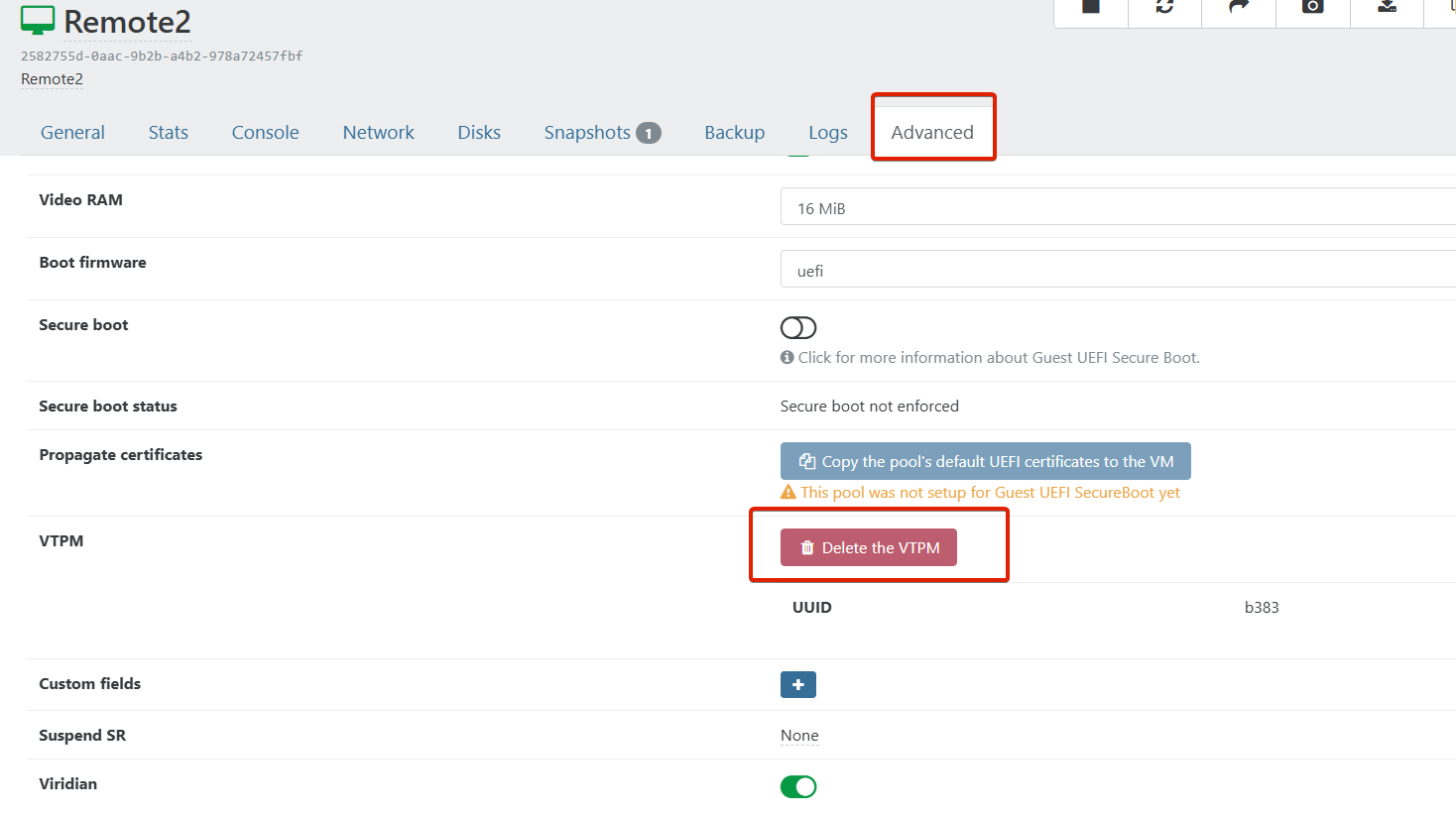
  • VTPM_MAX_AMOUNT_REACHED

    Unsolved Management
    4
    1
    1 Votes
    4 Posts
    1k Views
    I
    @olivierlambert - Just updating. The issue is still present in the version: 6.7.1. I doubt any fix was made. May be not many people are deploying windows 11 with vTPM through templates. Otherwise this issue should have been reported by others.
  • 5 Votes
    30 Posts
    8k Views
    CyrilleC
    @koushik you have to use the Helm controller addons for RKE2 to deploy autmatically the Helm chart for the Xen Orchestra CCM with the field spec.bootstrap set to true: Field | Default | Description -------------------------------------------------- `spec.bootstrap` | `false` | Set to True if this chart is needed to bootstrap the cluster (Cloud Controller Manager, etc) EDIT: I wrote a wiki page with what I've tested https://github.com/vatesfr/xenorchestra-cloud-controller-manager/wiki/Rancher-RKE2