Subcategories

  • VMs, hosts, pools, networks and all other usual management tasks.

    476 Topics
    4k Posts
    A
    @pkgw Planning an RPU as a whole is a nice idea in theory, but it's inherently designed to co-exist with normal pool management operations (you should still be able to migrate VMs between hosts B and C during it, or start new ones), we are not "pre-booking" memory and other resources for groups of VMs, otherwise it can quickly make the rest of the pool hard to manage while some VM migrations could still be far away. Regarding the narrower case - I'll note this down and see if we can improve things, thank you!
  • ACLs, Self-service, Cloud-init, Load balancing...

    105 Topics
    864 Posts
    M
    Is a centralized XOA server "managing" two remote Proxy-fronted XCP clusters supported with the SDN Controller Plugin? We are looking to deploy an architecture similar to this blog post from 2022: https://xen-orchestra.com/blog/xo-proxy-a-concrete-guide/
  • All XO backup features: full and incremental, replication, mirrors...

    515 Topics
    5k Posts
    poddingueP
    Thanks for checking. That's useful, even if it points away from where I was looking. Clocks within a second of each other means drift probably isn't your problem, and I'd guess the MST/UTC difference is just how dom0 displays it, though I'm not sure. What I keep coming back to is that your full backups fail while the delta jobs on the same hosts never do. That's the same split in https://github.com/vatesfr/xen-orchestra/issues/9181, where full backups hit BodyTimeoutError on VMs with big disks or a lot of free space and the deltas are fine. If your failing VMs look like that, your dates and the MST/UTC detail would do more good on that issue than buried in here. MajorP93 created this issue in vatesfr/xen-orchestra open Full backup fails on large VMs / VMs with lots of free disk space #9181
  • Everything related to Xen Orchestra's REST API

    86 Topics
    645 Posts
    J
    Hello I'm pulling stats for all VMs to understand CPU usage. We're a bit behind the curve in terms of XO versions, but these questions hopefully are still relevant. If using a granularity of days, the interval is set to 86400 (understandably) but the endTimestamp varies. Running this on June 9th @ ~1740 we get timestamps for both Mon Jun 8 01:00:00 AM BST 2026 and Tues Jun 9 01:00:00 AM BST 2026. Does this average across the day? Why is the timestamp 0100? Why would there be different timestamps between VMs (all are running) and does that mean that the figures are misaligned in the results? These are retrieved via curl and a bash script, a bit hacky, but for clarity the request is: ++ curl -X GET -s -H accept:application/json -b authenticationToken=[[REDACTED]] -o [[REDACTED]] 'https://[[REDACTED]]/rest/v0/vms/[[REDACTED]]/stats?granularity=days' Really keen to know if we can control the start and endtime, as well as provide a manual interval, as well as the aggregation strategy (min, max, average). Are any of these possible? Lastly, is cpuUsage the percentage as per the dashboard, but averaged over all CPUs? Thanks so much in advance. James
  • Terraform, Packer or any tool to do IaC

    51 Topics
    471 Posts
    poddingueP
    The Kubernetes CSI driver for Xen Orchestra just hit v0.4.0, and we want it on more real clusters before it reaches a stable release candidate. If you run Kubernetes on XCP-ng VMs, this is a good time to give it a proper workout. What's new in v0.4.0: Local-storage support Automatic pool-discovery fallback Kubernetes metadata now lives in Xen Orchestra VDI tags instead of the deprecated other_config. That change also drops the old requirement for Xen Orchestra 6.4 or newer, so the driver runs on more deployments now. ️ Read this before you upgrade. v0.4.0 is a breaking change. The Kubernetes metadata moved from other_config to VDI tags, so you must migrate before upgrading from v0.3.0. Do not upgrade in place: follow the v0.3.0 to v0.4.0 migration guide in the release notes, then move to v0.4.0. What helps us most is hearing how it behaves on your own setup: what works, what breaks, which storage backend you use, and which flavour of Kubernetes you run (k3s, full k8s, or something else). Edge cases on real clusters are the ones we don't see in our own testing. Where to report: start right here in this thread. It keeps everything visible to the community and lets others on the same setup jump in. If something turns out to be a reproducible bug, we'll move it to a GitHub issue on the repo so the team can track it to a fix. Release notes and migration guide: https://github.com/vatesfr/xenorchestra-csi-driver/releases/tag/v0.4.0
  • Cannot Download Exported VM After Export Task Completes Successfully

    Unsolved
    18
    2
    0 Votes
    18 Posts
    3k Views
    K
    @olivierlambert Yep. Here's the video of the test - https://www.youtube.com/watch?v=tiVdR74PNjw
  • SR_BACKEND_FAILURE_108 | Unable to Add a Second NFS Storage Repository

    Solved
    4
    0 Votes
    4 Posts
    866 Views
    ?
    @olivierlambert You're most welcome. XCP-ng + Xen Orchestra is a solid solution and I would very much like to see it get adopted within my organization, so I'll do anything (legal of course) to work through these problems and share the solutions, so the entire community can benefit.
  • Dynamic cloudinit network config [FEATURE REQUEST]

    7
    1
    0 Votes
    7 Posts
    2k Views
    D
    @julien-f Would that be something like this for a dynamic network config as an example? network: version: 1 config: - type: physical name: enX0 subnets: - type: static address: 192.168.99.{index}/24 gateway: 192.168.99.1 - type: nameserver address: - 172.31.31.1 - 192.168.45.11 search: - example.tld I plan to test this at some point, but I don't do a whole lot of bulk provisioning myself. Just curious.
  • Ubuntu 24.04 Cloud Image Template Not Working

    14
    0 Votes
    14 Posts
    7k Views
    D
    @encryptblockr said in Ubuntu 24.04 Cloud Image Template Not Working: did you mount the guest tools cdrom to the cloud image before you created a template from it? No, I just make my base images (for the end template) as generic as possible, and I do all mounts, package installs, accounts, keys, including the xe-guest utils package all in the user-data config for cloud-init. Makes the configurations more uniform across all stacks I have to maintain and scales really well with jinja templates. also what is point of {name}% in below? can you explain? where does it get {name} from and what is % use? That pulls the hostname from metadata that is provided by the nocloud datasource. If you ever want to see all the metadata available (for example, say your provisioning plane does dynamic configuration from some backend IAS platform, and you need logic that renders metadata to run different configurations; run the following after login: cloud-init query -a For example, I run different configurations based on what the 'distro' value is - example: cloud-init query -f {{v1.distro}} {% if distro in ['rocky', 'ol', 'centos', 'fedora', 'redhat', 'almalinux'] -%} //do the rpm things// This allows us to run completely different configuration settings based on what distro its being run in, or even what virtualization platform it is running on. Some platforms won't use the hostname, or fqdn meta values, so I have some if logic that only adds it when vendordata is null, example; {% if vendordata == '' %} fqdn: {name} {% endif %} Probably more than you wanted to know, but that's a brief summary of cloud-init metadata.
  • [SOLVED] How to install guest tools via apt?

    Solved
    2
    2
    0 Votes
    2 Posts
    7k Views
    E
    so i imported a new VM and made sure i mounted the guest-tools iso to it before converting it to template i just tried this and it worked!!! #cloud-config hostname: someotheruser ssh_authorized_keys: - ssh-rsa AAAAxxx - ssh-rsa AAAAxxx - ssh-ed25519 AAAAxxx runcmd: - [mkdir, -p, /mnt/guest-tools] - [mount, /dev/cdrom, /mnt/guest-tools] - [bash, /mnt/guest-tools/Linux/install.sh] - [umount, /dev/cdrom] - [rm, -rf, /mnt/guest-tools]
  • Can backups be "imported"?

    4
    0 Votes
    4 Posts
    1k Views
    J
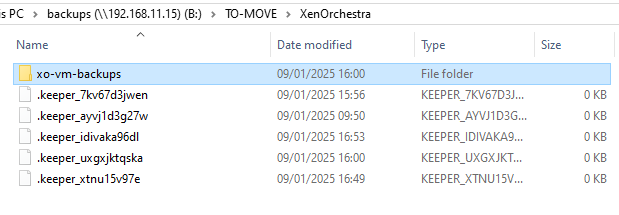
    @olivierlambert Based on what you mentioned about losing everything and rebuilding, if you reconnect to the NFS share, will you be able to see the VMs listed below, or would additional steps be required to recover them? Thanks! [image: 1733646346634-a2bede49-af10-45e8-9014-7c70143688cf-image.png]
  • pool cpu usage vs host cpu usage

    2
    3
    0 Votes
    2 Posts
    272 Views
    J
    figured it out... When under "Pool" view its displaying the "stacked" value and not the average value.
  • SR NFS Creation Error 13

    Solved
    19
    5
    0 Votes
    19 Posts
    4k Views
    T
    I ran into this problem with a fresh install of XCP-ng and TrueNAS last night. The fix is on TrueNAS, NFS Advanced Options, set the maproot user to 'root' and maproot group to 'wheel'. By default the fields are empty.
  • Remote not working

    1
    0 Votes
    1 Posts
    252 Views
    No one has replied
  • XOA Quick Deploy

    29
    1
    0 Votes
    29 Posts
    17k Views
    M
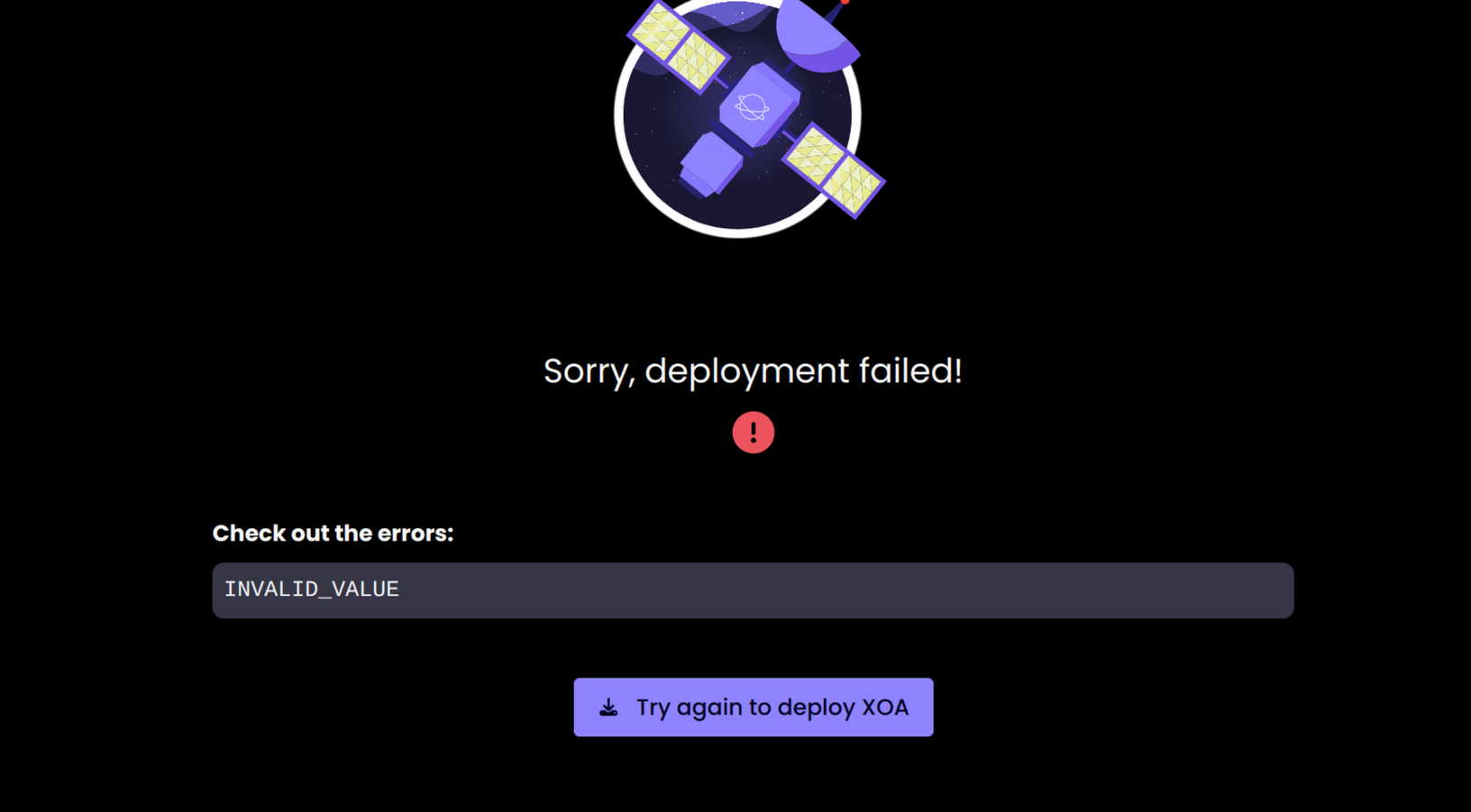
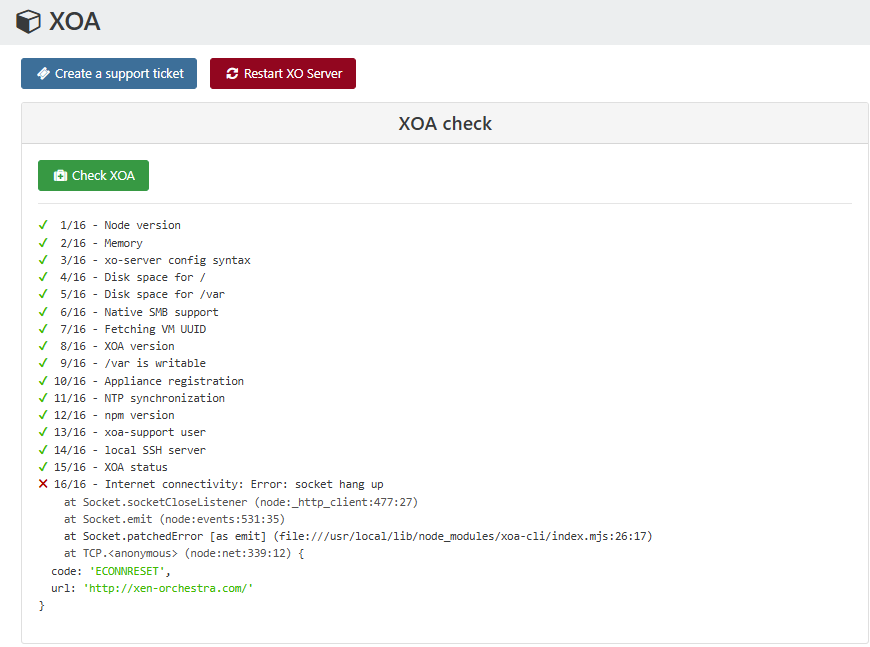
    I know this is quite old but wanted to update with additional findings. I had the same error and it turns out you are using a non-standard port. In this case, tcp/8888 which I have blocked on my perimeter firewall.
  • No plugins visible on XOA [SOLVED]

    Solved
    3
    1
    0 Votes
    3 Posts
    503 Views
    T
    That must explain one or two things Thx
  • Some VMs Booting to EFI Shell in Air-gapped XOA Instance

    7
    0 Votes
    7 Posts
    1k Views
    ?
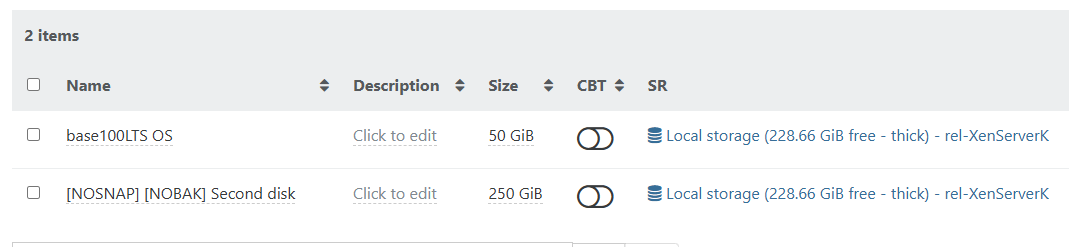
    Good-day Folks, While troubleshooting this issue with my sales rep, I shared a screenshot of one of my VMs and he noted that it was odd that the boot disk was connected as device xvdb instead of xvda. So he asked me to go through and check if the VMs that were having problems booting, looked similar. I went through and confirmed that all the VMs that were failing to boot did not have an “xvda” device. I went through the Storage menu and found a few disks that did not have a name or description, which was quite odd (to say the least). I mounted each disk, one at a time, to one of the VMs and booted until I identified and renamed each of them. As it stands now, I’ve been able to get all the VMs back up and running again. However, that leaves some unanswered questions: How does taking a snapshot of a the MAIL01 VM (which was built with two disks – Disk1 for OS and Disk2 for Data), cause the VM to have its xvda device detached, and snowball that to other VMs? How is it that VDIs that I name myself during VM creation, all of a sudden become detached from their VMs and lose their name and description? How does a VM Template lose its disk? Because I was able to identify the disk that’s supposed to be attached to the template, but now it’s orphaned, and I don’t know how to re-attach it to the template. In any case, I’m glad this happened in this lab environment, so I'm willing to work with you all at Vates to see if we can do a root cause analysis to prevent this in the future. All I did was take a snapshot, and this is certainly not the experience I should have had (nor is what I'm used to seeing). Some screenshots to illustrate what I saw: [image: 1732747097783-screenshot_netxms01_no_vdi.png] [image: 1732747097860-screenshot_netxms01_no_vdi_2.png]
  • new smb remote fails

    4
    0 Votes
    4 Posts
    876 Views
    G
    @gonzametal I modified sudoers and could create the folder in the terminar but the error still there (I think because the syscall). I will install as root again to avoid this kind of issues in the future
  • VDI migration

    8
    0 Votes
    8 Posts
    3k Views
    DanpD
    @sb2014 I've encountered this particular issue once before, and these were the steps we used to correct it -- Shutdown the VM Export the snapshot's VDI from the SR's DIsks tab using XVA file format Forget the snapshot Import the XVA file created in the earlier step Attach the newly imported disk to the target VM Start the VM to verify that it boots correctly Regards, Dan
  • Changing the VM Advanced setting "Viridian" doesn't stick

    2
    0 Votes
    2 Posts
    677 Views
    DanpD
    I confirm this behavior. Checking with the dev team to see if this is by design.
  • Active directory authentication

    12
    0 Votes
    12 Posts
    3k Views
    G
    @dinhngtu LDP is using SSL, and no firewall between, so I think there be a ldaps misconfiguration
  • Deleting a VM template?

    Solved
    3
    0 Votes
    3 Posts
    711 Views
    W
    @Danp Thanks. My fault, I didn't notice the 2nd page of templates where it was.
  • This topic is deleted!

    1
    0 Votes
    1 Posts
    1 Views
    No one has replied
  • xo-server-auth-saml

    2
    0 Votes
    2 Posts
    406 Views
    olivierlambertO
    Hi, You should use the UI to config the plugin, but I suppose you are asking to pass extra parameters that aren't displayed/existing?
  • Change the network device for remotes throws "mount.nfs: Connection timed out"

    Solved
    5
    0 Votes
    5 Posts
    997 Views
    R
    @olivierlambert Oh my... I totally forgot to change the network interface on XO after the change. That was my mistake. Sorry. But thanks a million for pointing it out.