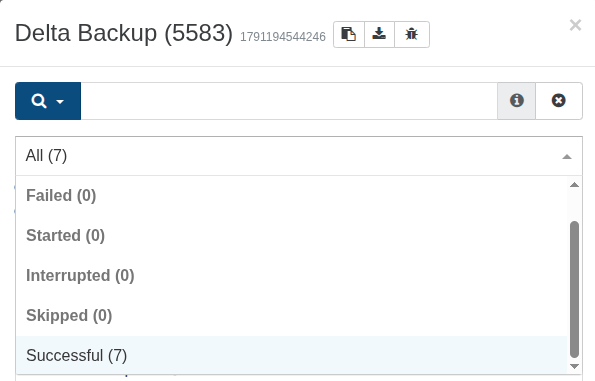
@paco Go to the vm in question and go to the storage and disable the CBT. Once migrated you can reneable or the backup job will reenable.
I had issues i could not move to new SR when CBT was enabled.
@paco Go to the vm in question and go to the storage and disable the CBT. Once migrated you can reneable or the backup job will reenable.
I had issues i could not move to new SR when CBT was enabled.
FYI we have the Broadcom NetXtreme Gigabit Ethernet (BCM5720) in Dell R660 and Broadcom Adv. Dual 10GBASE-T Ethernet in Dell r640.
Currently have no issues with ether nic in XCP-NG 8.3
I can confirm with @probain with UI bug.
If i start new vm from template and select the template Ubuntu 24.04.3 to start.

Then switch to any other template (pic below shows Rocky Linux template) the storage name does update by adding *_qxaj at the end but still remains named ubuntu not rocky linux. Also see the description bug appear.

If i switch back to the original template (second template switch) the storage name drops the _qxaj and description bug goes away.
@marcoi check with who wrote your script to install XO from sources.
https://github.com/ronivay/XenOrchestraInstallerUpdater - this has a option in config file to enable v6 during install/upgrade.
or try -
cd /opt/xo/xo-web
yarn run turbo run build --filter @xen-orchestra/web
@olivierlambert Thank you for the reply. There was a thread on here about the iso not being mounted properly and I commented about having power off the vm and back and it will load the iso.
This is specifically true with the 0.4.0 for linux. Image pulled from the XO Hub will not mount the ios if the vm is powered on. There is Yellow Explanation mark next to it. Power off vm and power on vm iso is ok. Reboot vm does not let the ios to work.
@bvitnik thanks didnt know about the purge option. It didnt show on sudo apt --help
Are the new rust xen-guest-agent ready for production? Should I stay with the traditional xe-guest-utilities on the guest tools iso?
While trying to uninstall the xen-guest-agent and install the xe-guest-utilities I ran into this...
Is dpkg -l | grep xe not the proper way to detect what tools is installed?
test@Test:~$ dpkg -l | grep xe
ii byobu 6.11-0ubuntu1 all text window manager, shell multiplexer, integrated DevOps environment
ii libxext6:amd64 2:1.3.4-1build2 amd64 X11 miscellaneous extension library
ii plymouth 24.004.60-1ubuntu7.1 amd64 boot animation, logger and I/O multiplexer
ii plymouth-theme-ubuntu-text 24.004.60-1ubuntu7.1 amd64 boot animation, logger and I/O multiplexer - ubuntu text theme
ii publicsuffix 20231001.0357-0.1 all accurate, machine-readable list of domain name suffixes
ii python3-pyparsing 3.1.1-1 all alternative to creating and executing simple grammars - Python 3.x
ii screen 4.9.1-1build1 amd64 terminal multiplexer with VT100/ANSI terminal emulation
ii tmux 3.4-1ubuntu0.1 amd64 terminal multiplexer
ii whiptail 0.52.24-2ubuntu2 amd64 Displays user-friendly dialog boxes from shell scripts
ii xe-guest-utilities 7.30.0-13 amd64 Virtual Machine Monitoring Scripts
rc xen-guest-agent 0.4.0 amd64 Guest Agent for Xen-based virtual machines
test@Test:~$ sudo apt remove xen-guest-agent
Reading package lists... Done
Building dependency tree... Done
Reading state information... Done
Package 'xen-guest-agent' is not installed, so not removed
0 upgraded, 0 newly installed, 0 to remove and 27 not upgraded.
test@Test:~$ dpkg -l | grep xe
ii byobu 6.11-0ubuntu1 all text window manager, shell multiplexer, integrated DevOps environment
ii libxext6:amd64 2:1.3.4-1build2 amd64 X11 miscellaneous extension library
ii plymouth 24.004.60-1ubuntu7.1 amd64 boot animation, logger and I/O multiplexer
ii plymouth-theme-ubuntu-text 24.004.60-1ubuntu7.1 amd64 boot animation, logger and I/O multiplexer - ubuntu text theme
ii publicsuffix 20231001.0357-0.1 all accurate, machine-readable list of domain name suffixes
ii python3-pyparsing 3.1.1-1 all alternative to creating and executing simple grammars - Python 3.x
ii screen 4.9.1-1build1 amd64 terminal multiplexer with VT100/ANSI terminal emulation
ii tmux 3.4-1ubuntu0.1 amd64 terminal multiplexer
ii whiptail 0.52.24-2ubuntu2 amd64 Displays user-friendly dialog boxes from shell scripts
ii xe-guest-utilities 7.30.0-13 amd64 Virtual Machine Monitoring Scripts
rc xen-guest-agent 0.4.0 amd64 Guest Agent for Xen-based virtual machines
test@Test:~$
@bvitnik said in Custom config / cloud-init:
@acebmxer Did you do:
cloud-init clean --logs --seedbefore converting the VM to template?
Also, network configuration is not part of the
cloud-config(aka user data). In XO, there is a separate field called "Network config" where it should be specified. See examples at the end of the guide I pasted earlier.network:key should also be removed (commented in the examples).
besides getting it working on fresh vm from the ubuntu template from the Hub. I do have that command in script to prepare the vm to create a template from it. AI says this will cause the vm not to recreate the 50-cloud-init.yaml file. So how do I work around that also.
@bvitnik
This is creating new vm from Hub template. If i try the below network config the VM hangs on boot. Think previously it would eventually boot but have not networking as stated previously.
#cloud-config
# network:
version: 2
ethernets:
enX0:
dhcp4: true
dhcp6: false
set-name: "enX0"
This is copy pasted from the link you provided about additional infomation to add to documentation. does not show network: commented out. When i use this with ips corrected to my network the vm boots fast but again still no networking. Even if i comment out network. Still no networking. I have to leave blank during vm creation. Can you past your working network config?
#cloud-config
network:
version: 2
ethernets:
eth0:
dhcp4: false
addresses:
- 10.0.2.6/27
gateway4: 10.0.2.1
nameservers:
addresses:
- 10.0.2.1
- 1.1.1.1
EDIT -
This is a working config for new vm from Ubuntu Hub template. VM boots and gets IP address. Its not much different then my original. I dont know. Still learning this stuff.
network:
version: 2
ethernets:
enX0: # or whatever your interface name is
dhcp4: true
Edit -2 while the above works for dhcp the below does not work for static. VM does not get static ip
network:
version: 2
ethernets:
enX0: # or whatever your interface name is
dhcp4: false
addresses: - 10.100.10.206/24
gateway4: 10.100.10.254
nameservers:
addresses:
- 10.100.10.254
- 1.1.1.1
@Pilow
Yeah still dont know why i dont see it in my production envorioment but yes the most recent file from home lab is 5k lines saved as txt file only 756KB in size. Yes i see alot off information in that file.
Production has no backup job for pool metadata / config. I assumed that backup to vates would be the same? But since they are not stored locally that would be why?
@Pilow Yes i do have Audit logs enabled but i do not have any metadatabackup.list.... Maybe a setting in backup job?

While my production XOA environment did not my home lab does...

@Pilow While i havent had that issue that i am aware of. I have noticed that the backup restore points for the proxy specifically are slow to load. Even when deleting large quantities of backups to the point it stops reporting to XOA until some time of processing.
So I have had some more time to play around with this, and I think I got it working except for one part.
After I convert the vm to a template and go deploy new vm with newly created template. Even if i put in the network config as such.
#cloud-config
network:
version: 2
ethernets:
enX0:
dhcp4: true
dhcp6: false
set-name: "enX0"
The new vm does not get IP address. When i log into new vm it does not have /etc/netplan/50-cloud-init.yaml with the above network config.
If i manually create the file with the above config and reboot the vm gets an IP address and a different one then previous vm
Just tried again accessing xo-ce without reverse proxy and same thing.
Edit unless this is by design. If the ISO sr is expected to only be interacted with vis XO interface.


@olivierlambert I dont think it was mentioned that XO is reporting the incorrect name of the ios, rather the sr itself when looking a from diffrent way. As my XO reports the correct name but when viewing the ios sr from my windows pc vis smb i see the uuid.img.
Edit- Fired up a copy of XOA and it sees iso in sr correct just like my ox-ce.
I thought i tried this before last time this came up, but i just tried now and it did upload as uuid.img.
Possibly reverse proxy is doing this? I use Nginx Proxy manager as reverse proxy. In XO via proxy upload iso to iso sr and moments later uuid.img in iso sr.
While XO is still showing the correct .iso name the actuall iso sr have uuid.img on the share looking at it vs smb from windows client for me.


@mguimond
Not sure how old your XO is but this is the current Commit. Master, commit 5349f. Suggest try updating and try again. Maybe someone from Vates will have more information.
Prior to myself finding that option in the config file use to run this command that worked as well..
cd /opt/xo/xo-web
sudo yarn run turbo run build --filter @xen-orchestra/web
Reach out to who's script you are using for deploying XO from sources.
This script - https://github.com/ronivay/XenOrchestraInstallerUpdater there is an option in the config file to enable XOv6. There are concerns with not being fully ready to its disabled by default. I currently have not any issues related to that.