XCP-ng
    • Categories
    • Recent
    • Tags
    • Popular
    • Users
    • Groups
    • Register
    • Login
    • Profile
    • Following 0
    • Followers 0
    • Topics 49
    • Posts 516
    • Groups 0
    acebmxerA Offline
    1. Home
    2. acebmxer
    3. Topics

    Topics

    • acebmxerA

      VM Display Resolution

      Watching Ignoring Scheduled Pinned Locked Moved XCP-ng
      3
      0 Votes
      3 Posts
      108 Views
      poddingueP
      It was too tempting not to test, so I went and tested the other half. On an 8.3 host I set the preferred resolution to 800x600 in the OVMF menu on a UEFI Debian VM, turned that VM into a template, and cloned it. The clone came up at 800x600. A control clone of the same original, with nothing set, came up at 1024x768. So your workaround holds, the resolution really does ride along into VMs built from the template. For anyone who wants to poke at it, the setting is a UEFI variable called PlatformConfig under GUID 7235c51c-0c80-4cab-87ac-3b084a6304b1. It only appears in NVRAM once you commit it in the menu, and it stores width and height as plain little-endian integers, which is why it travels with the VM record. One thing I didn't expect: the OVMF help text says the mode list is filtered against video RAM size, but the VM I used had the default 4 MB and still offered everything up to 1280x1024. So you may not need to raise videoram for the common ones. Fair warning though, I measured the console at the firmware stage rather than after the distro's own driver takes over, so a guest that sets its own mode later could still override it. At least, that's my understanding.
    • acebmxerA

      Veeam for Xen Orchestra has been release today 13.1

      Watching Ignoring Scheduled Pinned Locked Moved Backup
      25
      0 Votes
      25 Posts
      2k Views
      acebmxerA
      So I ended up going with the Windows B&R as i could net setup the windows mount server when setting up the repo for the backups. It would setup the linux one but not the windows one. This was with using the veeam console from a windows client. So i ended up with the Windows one. Now after a few backups i am see this warning / error.... 8/5/2026 5:34:50 PM Warning : Failed to use CBT: [Task e75c4247-2ee1-7b51-088c-b970ace60f3d (Async.VDI.list_changed_blocks) failed: . SR_BACKEND_FAILURE_460. . Failed to calculate changed blocks for given VDIs. [opterr=Source and target VDI are unrelated] First i thought it was because i maped the new job to older backups from Beta v1. So i purged all old backups and started fresh. The full backups were successful. Now on first delta 4 out of 7 vms have that warrning. This a Veeam issue or xcp-ng?
    • acebmxerA

      Deploy VM via cloud-init config

      Watching Ignoring Scheduled Pinned Locked Moved Solved Xen Orchestra
      9
      1
      0 Votes
      9 Posts
      431 Views
      MathieuRAM
      @acebmxer Thank you for your quick feedback.
    • acebmxerA

      Unable to fetch latest master commit.

      Watching Ignoring Scheduled Pinned Locked Moved Solved Xen Orchestra
      17
      1
      1 Votes
      17 Posts
      1k Views
      TS79T
      @acebmxer all good and thank you again for sharing your discovery on the forums
    • acebmxerA

      v6 UI VDI's not being shown all the time.

      Watching Ignoring Scheduled Pinned Locked Moved Solved Xen Orchestra
      6
      3
      0 Votes
      6 Posts
      511 Views
      poddingueP
      @acebmxer No problem, that's excellent news, thanks for the feedback!
    • acebmxerA

      Backups failing back to Full Backups

      Watching Ignoring Scheduled Pinned Locked Moved Backup
      9
      0 Votes
      9 Posts
      623 Views
      olivierlambertO
      Indeed, it should be detected/reported correctly to avoid losing time finding the problem. Let me ping @julienXOVates
    • acebmxerA

      xo-apply — configuration-as-code for Xen Orchestra (looking for feedback & testers)

      Watching Ignoring Scheduled Pinned Locked Moved Xen Orchestra
      4
      1 Votes
      4 Posts
      467 Views
      acebmxerA
      Added local user support. Current sample config file. # Example xo-apply configuration. # Copy this into your own PRIVATE repo, edit, then: # export XO_URL=https://xo.example.lan XO_TOKEN=... # xo-apply diff config.yaml # xo-apply apply config.yaml # # Secrets never go in this file: use ${env:VAR_NAME} placeholders, # resolved from environment variables when the tool runs. # # A section that is ABSENT is unmanaged (xo-apply won't touch or report that # resource type). A present-but-empty section means "manage this type, none # should exist" (only deleted when you pass --prune). remotes: # NFS share on a NAS - name: nas-backups type: nfs host: 192.168.1.50 path: /export/xo-backups # port: 2049 # optional # mountOptions: vers=4 # optional mount(8) options # SMB / Windows share — host is "HOST\share" (single backslash in YAML # double-quoted strings must be written as \\) - name: windows-share type: smb host: "192.168.1.60\\backups" domain: WORKGROUP username: backup password: ${env:SMB_BACKUP_PASSWORD} # path: xo # optional subfolder inside the share # S3-compatible object storage (AWS, MinIO, Backblaze B2, ...) - name: offsite-s3 type: s3 host: s3.us-east-1.amazonaws.com path: my-bucket/xo-backups # bucket/directory accessKey: AKIAEXAMPLE secretKey: ${env:S3_SECRET_KEY} region: us-east-1 # protocol: http # for http-only endpoints (e.g. local MinIO) # Directory local to the XO VM (e.g. a mounted USB disk) - name: local-disk type: local path: /mnt/backup-disk backupJobs: # Delta (incremental) backup of every VM tagged "critical", every night - name: nightly-critical mode: delta vms: tag: critical remotes: [nas-backups, offsite-s3] settings: # optional global job settings, passed through to XO concurrency: 2 # timezone: America/New_York # maxExportRate: 104857600 # bytes/s # nRetriesVmBackupFailures: 2 # reportWhen: failure schedules: - name: nightly cron: "0 2 * * *" retention: 14 # backups kept on the remotes # snapshotRetention: 3 # snapshots kept on the pool # timezone: America/New_York # enabled: false # schedules are enabled by default # Weekly full backup of specific VMs, selected by name - name: weekly-full mode: full compression: zstd vms: names: [dc-01, mail-01] # ...or select by uuid: uuids: [770aa52a-fd42-8faf-f167-8c5c4a237cac] # ...or pass a raw XO smart-mode pattern for anything more complex: # raw: # type: VM # tags: # __or: [[prod]] remotes: [nas-backups] schedules: - name: weekly cron: "0 3 * * 0" retention: 8 # Disaster Recovery / Continuous Replication: instead of (or in addition to) # remotes, target one or more SRs. mode:full => DR, mode:delta => CR. - name: dr-critical mode: full # delta = Continuous Replication vms: tag: critical srs: [4991d4aa-ed84-599b-7d19-97f2f943a366] # target SR UUID(s) # remotes: [] # SR-only is fine; may be combined with remotes schedules: - name: hourly-dr cron: "0 * * * *" retention: 3 # replicas kept on the SR # Metadata backups: pool metadata and/or XO's own configuration. metadataBackups: - name: xo-config xoMetadata: true # back up XO's own config pools: [939ed551-fbd6-9868-52d8-d3997b7bf7da] # pool UUID(s) for pool metadata remotes: [nas-backups] schedules: - name: daily cron: "0 21 * * *" xoRetention: 7 # XO metadata backups kept poolRetention: 7 # pool metadata backups kept # Mirror backups: copy an existing remote's backups onto other remote(s), # e.g. push local backups offsite to S3. mirrorBackups: - name: offsite-mirror mode: full # full or delta, to match the source backups sourceRemote: nas-backups remotes: [offsite-s3] schedules: - name: nightly-mirror cron: "0 5 * * *" retention: 14 # Sequences: run backup schedules one after another. Each step names a job and # one of its schedules (from any job kind above, or already in XO). The sequence # has its own cron for when the whole chain runs. sequences: - name: nightly-then-metadata steps: - { job: nightly-critical, schedule: nightly } - { job: xo-config, schedule: daily } cron: "0 22 * * *" # enabled: false # sequences are enabled by default # timezone: America/New_York # Local users (XO's internal auth provider). Users created by an external auth # plugin (LDAP/SAML/GitHub) are NOT managed here and are never pruned. # # Passwords are write-only: XO never returns them, so a real password can't be # exported or diffed — but XO REQUIRES a password to create a user. So `export` # writes the placeholder `password: ChangeMe` for every user. # ⚠️ CHANGE these before importing into a real XO (or use a ${env:...} ref), # otherwise every new user is created with the password "ChangeMe". # The password is only used when a user is CREATED; for an existing user it is # ignored (change it in the XO UI). Only `permission` is compared for drift. users: - email: ops@example.com password: ChangeMe # required by XO; change before import permission: admin # none | read | write | admin (default: none) # Local groups. Members are referenced by email and resolved to ids at apply # time; each member must be a user defined above or already present in XO. groups: - name: operators users: [ops@example.com]
    • acebmxerA

      XO unresponsive when Remote storage is offline.

      Watching Ignoring Scheduled Pinned Locked Moved Management
      4
      0 Votes
      4 Posts
      470 Views
      olivierlambertO
      Great! I think this is really the best possible approach to make it clean
    • acebmxerA

      v6 left navigation bar

      Watching Ignoring Scheduled Pinned Locked Moved Xen Orchestra
      2
      3
      0 Votes
      2 Posts
      748 Views
      olivierlambertO
      Thanks, I made the feedback to the XO team, this will be fixed ASAP.
    • acebmxerA

      Some dashboard loading issues with v6

      Watching Ignoring Scheduled Pinned Locked Moved Solved Xen Orchestra
      27
      5
      0 Votes
      27 Posts
      4k Views
      acebmxerA
      @simonp said: @acebmxer Hi, Thanks to your help we were able to identify an issue with Redis that we think is the source of the v6 dashboard loading issue. Could you try and checkout the fix_redis_encryption_issue branch, rebuild xo and restart ? This should solve the 401 issues. Switched back to Master branch and made some changes to my install script. add diagnostics for missing XO 6 web UI build artifacts Plain bash [[ -f ]] fails silently on unreadable paths owned by SERVICE_USER, causing false-positive missing-artifact warnings. Switch all file/dir tests and grep calls to use sudo. SUCCESS] Xen Orchestra built successfully [INFO] Build verification passed: dist — all JS chunks present. [INFO] Build verification passed: dist — all JS chunks present. [INFO] Creating systemd service... [SUCCESS] Systemd service created and enabled [INFO] Configuring sudo for xo-service (mount/umount/findmnt)... [SUCCESS] Sudo configured for xo-service (mount, umount, findmnt) [INFO] Applying security hardening... [INFO] Starting xo-server service... [INFO] Waiting for Xen Orchestra to become ready (up to 60s)... [INFO] Not ready yet (attempt 1/10), retrying in 6s... [SUCCESS] Xen Orchestra is ready (HTTPS on port 443) [SUCCESS] Update completed successfully! [INFO] New commit: 0f29421627c7 v6 Dashboard still loading correctly. Thank you for the fix.
    • acebmxerA

      Backups with qcow2 enabled

      Watching Ignoring Scheduled Pinned Locked Moved Backup
      29
      3
      0 Votes
      29 Posts
      4k Views
      poddingueP
      The progress bar issue you and Florent were chasing looks fixed in 6.7 (PR #10133). Worth upgrading and seeing if it moves now instead of sitting still. Separately, since this thread is specifically about QCOW2 backups: 6.7 also fixes an offset bug that could leave incremental backups mostly empty after the first block when NBD isn't enabled. Worth a look at the release notes if that's your setup too.
    • acebmxerA

      Backup Info under VM tab in v6 never loads...

      Watching Ignoring Scheduled Pinned Locked Moved Backup
      65
      2
      0 Votes
      65 Posts
      9k Views
      P
      @MathieuRA said: Hi, regarding your backups which do not appear on the XO5 restore page, I suggest you to open a new topic Forgot to include the link to the new topic https://xcp-ng.org/forum/topic/12040/restore-only-showing-1-vm
    • acebmxerA

      Lates commit breaks install

      Watching Ignoring Scheduled Pinned Locked Moved Management
      19
      0 Votes
      19 Posts
      2k Views
      acebmxerA
      @gregbinsd let us know. If you do use my script. It pulls nodejs from NodeSource so it may not install the latest 24.15.0 tls. If you specific 24.15.0 it will install that version. If you need to change node version with my script use the rebuild option.
    • acebmxerA

      VHD Check Error

      Watching Ignoring Scheduled Pinned Locked Moved Backup
      13
      1
      0 Votes
      13 Posts
      1k Views
      poddingueP
      Pilow's right that moving a VM to another SR forces one full pass while the CBT bitmap is rebuilt; that part is expected. But your screenshot actually shows the likely culprit for the all-VMs-fall-back-to-full pattern: you have Purge snapshot data when using CBT enabled, and XO's incremental backup docs flag exactly that combination as a known issue where you can occasionally get unexpected fulls: https://docs.xen-orchestra.com/xo5/incremental_backups#known-issues. It might be worth running a few jobs with that toggle off to see if the deltas hold. It is a known rough edge on the CBT side, so following the central CBT feedback thread and maybe a nudge to @Team-XO-Backend wouldn't hurt.
    • acebmxerA

      Migrations after updates

      Watching Ignoring Scheduled Pinned Locked Moved Xen Orchestra
      13
      2
      0 Votes
      13 Posts
      1k Views
      Bastien NolletB
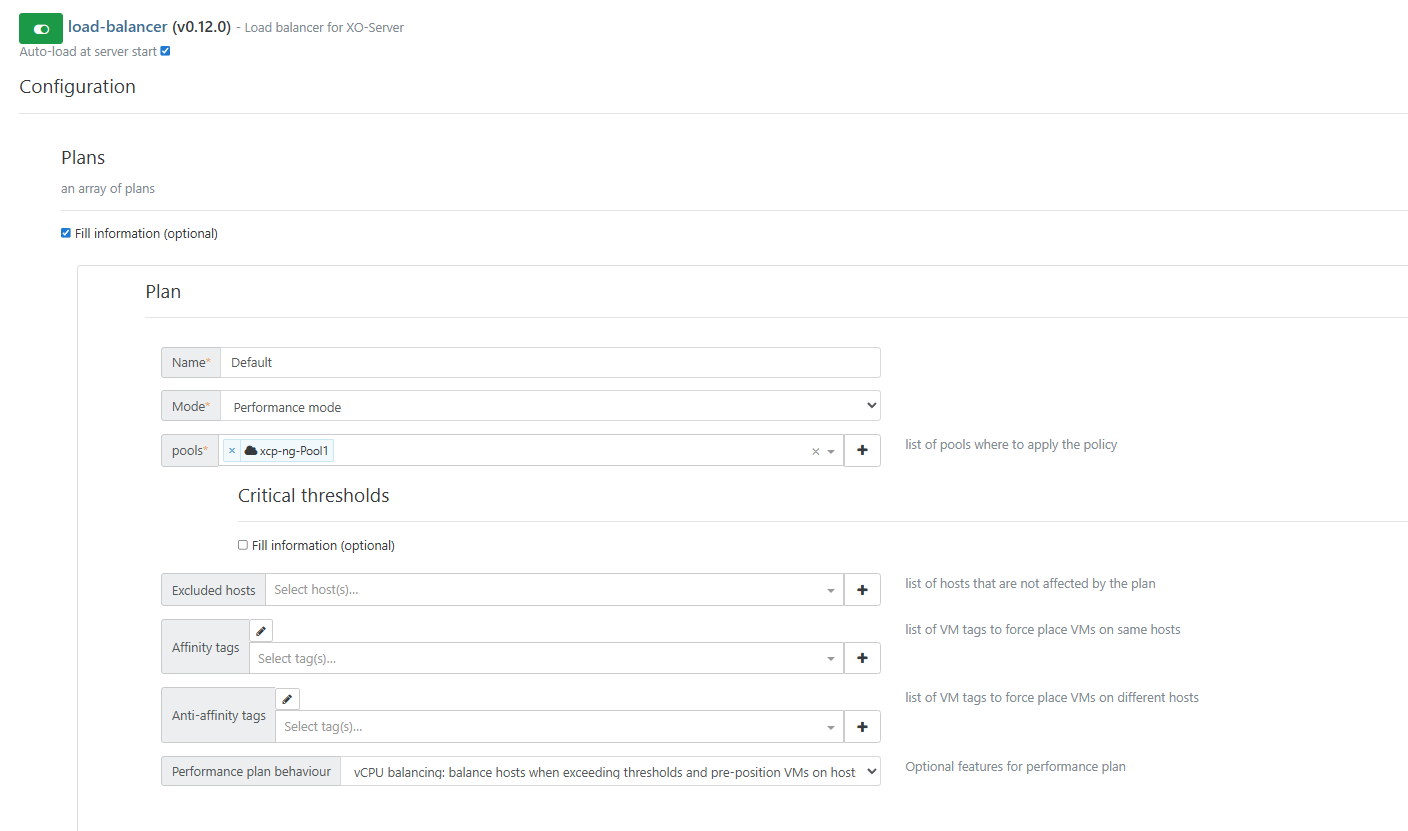
      Hi @acebmxer, I've made some tests with a small infrastructure, which helped me understand the behaviour you encounter. With the performance plan, the load balancer can trigger migrations in the following cases: to better satisfy affinity or anti-affinity constraints if a host has a memory or CPU usage exceeds a threshold (85% of the CPU critical threshold, of 1.2 times the free memory critical threshold) with vCPU balancing behaviour, if the vCPU/CPU ratio differs too much from one host to another AND at least one host has more vCPUs than CPUs with preventive behaviour, if CPU usage differs too much from one host to another AND at least one host has more than 25% CPU usage After a host restart, your VMs will be unevenly distributed, but this will not trigger a migration if there are no anti-affinity constraints to satisfy, if no memory or CPU usage thresholds are exceeded, and if no host has more CPUs than vCPUs. If you want migrations to happen after a host restart, you should probably try using the "preventive" behaviour, which can trigger migrations even if thresholds are not reached. However it's based on CPU usage, so if your VMs use a lot of memory but don't use much CPU, this might not be ideal as well. We've received very few feedback about the "preventive" behaviour, so we'd be happy to have yours. As we said before, lowering the critical thresholds might also be a solution, but I think it will make the load balancer less effective if you encounter heavy load a some point.
    • acebmxerA

      Issues with new vm after latest 8.3 updates (priror to release)

      Watching Ignoring Scheduled Pinned Locked Moved Solved XCP-ng
      4
      1 Votes
      4 Posts
      875 Views
      olivierlambertO
      No worries, it happens! Glad you found the problem
    • acebmxerA

      IPMI Info Outlet Air temp missing.

      Watching Ignoring Scheduled Pinned Locked Moved Xen Orchestra
      10
      2
      0 Votes
      10 Posts
      1k Views
      J
      @acebmxer I’m sorry to say that if those Dells are at your workplace, the wrong edition of iDRAC was purchased. You see with at the very least iDRAC 9 access to the full granular IPMI sensor data, was placed behind an edition paywall by Dell Technologies. Outlet temperature is just one of the feeds, missing from the Enterprise or lower edition of iDRAC 9. You’ll get the temperature readings from the Dell iDRAC web browser based interface, but not IPMI with iDRAC 9 Enterprise. To obtain the full IPMI sensor data you need the Datacenter edition.
    • acebmxerA

      Install XO from sources.

      Watching Ignoring Scheduled Pinned Locked Moved Xen Orchestra
      31
      3 Votes
      31 Posts
      8k Views
      acebmxerA
      v0.4.0 Release - https://github.com/acebmxer/install_xen_orchestra/releases 0.4.0 - 2026-08-23 Changed The cloud image is staged on the pool master by default instead of being streamed. Staging is the only path that can resume a broken download, retry a transient failure, and check the downloaded size before anything reaches the VDI; streaming can do none of those, because a pipe already feeding a fixed-Content-Length PUT cannot be rewound. On a link that drops the occasional TLS record — which any multi-gigabyte transfer eventually meets — streaming failed every attempt while staging rode it out. Streaming is now what it should always have been: the fallback for a host without the few gigabytes of scratch space staging needs. Fixed A stalled streaming import no longer has to be interrupted by hand. When the download end died, the upload sat waiting for a response XAPI would never send. --speed-time could not help — by that point curl is waiting, not transferring, so the speed meter has stopped ticking and only --max-time 3600 would eventually fire. The two transfers now run as separate processes with the download's exit status watched, and the upload is killed the moment it fails. A pool master short on scratch space no longer fails the whole deploy. The staged path signalled "no room" with a plain non-zero return, which under set -e took the script down before the fallback could be reached. A failed cloud-image download no longer looks like a successful import. The streaming import piped one curl into another, and the remote shell reported only the upload side's exit status. A download that died partway — a transient SSL_read ... bad record mac on a 3 GB transfer is the usual cause — therefore produced a truncated disk that the deploy reported as imported, and a VM that booted into a corrupt filesystem. The pipeline now runs under bash -o pipefail. A broken image download no longer hangs the deploy for an hour. When the download end died, the upload curl had already promised XAPI an exact Content-Length and sat waiting to send bytes that were never coming, with XAPI waiting alongside it until --max-time 3600 expired — the visible symptom being a XAPI task frozen at partial progress and a script that had to be interrupted. Both ends now abort after 60s below 1 KiB/s. The staged image download resumes instead of starting over. It now uses -C - with --retry 5 --retry-delay 3 --retry-all-errors, so the transient TLS failures that a multi-gigabyte single-connection download eventually hits are ridden out rather than failing the deploy. The streaming path deliberately does not retry: curl re-issues from byte 0, and piped into a fixed-Content-Length PUT those bytes would be appended to the ones already sent, corrupting the image while appearing to succeed. A short staged download is refused rather than imported. The file's size is now checked against the length the server advertised before anything is written into the VDI. The staged download reports progress. It was silent for several minutes on the longest step of the deploy, which reads as a hang worth killing. A failed deploy names the VM it left behind, with the xe vm-destroy command, instead of leaving a half-built VM to be rediscovered later in the pool's VM list. Nothing is destroyed automatically. --update/--reconfigure/--rebuild no longer abort on a root install. Reading User= from a systemd unit that has no such line (which is what a root install looks like) failed the pipeline under set -o pipefail and took the script down before the fallback could run. Deploy prompts validate values, not just their shape. 999.999.999.999 was accepted as an address and 70000 as a port; both were only rejected after the VM existed, by an unreachable guest or by the installer inside it. Prompted settings are no longer lost when the base config omits the key. The generated xo-config.cfg was patched with sed, which silently does nothing for a key that is not there — so the VM installed on the default while the summary showed the value you typed. Missing keys are now appended. An $EDITOR with arguments works. code --wait passed the availability check and then failed with "No such file", since the whole string was treated as one executable path. Values edited into the config are validated. An unusable port or branch was silently ignored, leaving the summary showing one thing and the VM installing another. Troubleshooting commands point at a key that still exists. The ssh -i lines printed on a failed install and on a non-200 health check named the temporary key, which the exit trap had already deleted. A second VM with the same hostname no longer overwrites the first one's SSH key, which was the only way into that machine. The disk-space check before staging an image on the pool master is derived from the image's actual size instead of a hard-coded 4 GiB, which rejected small images and let large ones fill /var/tmp mid-download. tests/probe-xapi-deploy.sh acquires its XAPI session from the pool master, the way --deploy does, so a firewall that blocks port 443 from your workstation no longer skips the HTTP transport probes that matter. It also validates --host, --user, --sr, --image and --payload-mb before they reach a shell, drops the eval in the workstation-side transport, and exits non-zero when any probe failed rather than whenever one transport worked. The menu example in the README and the layout comment above MENU_NAMES described the old fixed 5/4/centered grid; with ten items the menu draws five entries in each column. Security The cloud image is verified against its published checksum. The size check catches a download that was cut short; it cannot catch one that arrived complete from the wrong place, because a substituted image has a perfectly consistent Content-Length. The staged image is now checked against the SHA512SUMS its origin publishes beside it — which is what Debian ships — and a mismatch aborts before anything reaches the disk. An origin that publishes no sums warns and continues, so a custom XO_DEPLOY_IMAGE_URL keeps working. Set XO_DEPLOY_IMAGE_SHA512 to require a specific digest instead: that makes the check mandatory, aborting rather than continuing unverified, and refuses the streaming import outright because a pipe fed straight into the VDI leaves no file to hash. Fetching sums over the same connection as the image is not a detached signature — it defends against a bad mirror or a stale cache, not an attacker holding the TLS session for both requests. A pinned pool-master fingerprint is now enforced instead of advised. deploy_verify_host_key fingerprinted the host key and then returned success on every path that could not complete the check — so with XO_DEPLOY_POOL_FINGERPRINT set, a ssh-keyscan that timed out meant the host password was sent to whatever answered on that address, which is exactly what pinning exists to prevent and the easiest outcome for an on-path attacker to arrange. A pin that cannot be checked is now a hard failure. The verified host key is bound to the connection that carries the password. The scanned key was fingerprinted, shown, and then discarded, while dom0_exec connected with StrictHostKeyChecking=accept-new against the default known_hosts — verifying one transaction and trusting another. Nothing stopped a different key, or the host's RSA key when the ED25519 one had been displayed, being accepted at connect time. The whole scan is now pinned into a run-scoped known_hosts that dom0_exec enforces with StrictHostKeyChecking=yes, the same way deploy_wait_for_guest already treated the guest. A hostile pool master can no longer run commands on the workstation. The free-space probe in deploy_import_vdi_staged fed the host's reply straight into (( )), which expands an array subscript before evaluating it — so an answer of PATH[$(...)] executed locally rather than being rejected. It is now checked against ^[0-9]+$ first, matching the guards already applied to size and got in the same function. Note that set -euo pipefail does not cover this: set -u blocks only the unbound-variable form of the payload. This mattered more after staging became the default import path, because the probe went from rarely reached to running on every deploy. The pool master's root password is no longer visible in ps. Three calls predating dom0_exec still used sshpass -p "$HOST_PASSWORD", putting the password in the process list where any other user on the workstation could read it. They now use sshpass -e with $SSHPASS, as dom0_exec does. The admin password hash is kept out of XO_DEBUG=1 output. deploy_harden_guest_sudo and deploy_build_config_drive were missing the local - / set +x guard the rest of the script uses, so the hash was printed by xtrace. Previously masked on automated runs only because --non-interactive left the hash empty; requiring a password made it reachable on every deploy. Revoking the deployment key can no longer empty authorized_keys. A grep failure — no space for the temporary file, an unreadable source — was swallowed by || true and the empty result written back, taking the operator's own key with it. grep's "nothing matched" (a legitimate empty result) is now distinguished from a real error, which aborts and leaves the file untouched. The streaming import's FIFO is created inside a private directory. mktemp -u returns a name without creating anything, leaving a window in dom0's world-writable /tmp. The FIFO now lives in a mktemp -d directory. DSA public keys are rejected. ssh-dss was accepted by deploy_load_pubkey, but OpenSSH has refused DSA since 7.0 and removed it in 9.8, so it only installed a key that silently never worked. The cloud-init cache scrub covers cloud-config.txt. The rendered config holds hashed_passwd just as the raw user-data does; only the latter was being redacted. The deployment SSH key is destroyed at the end of a deploy. It used to be...
    • acebmxerA

      XOA - Memory Usage

      Watching Ignoring Scheduled Pinned Locked Moved Xen Orchestra
      48
      2
      0 Votes
      48 Posts
      9k Views
      acebmxerA
      @florent said: @acebmxer back to work thank you for yor patience and help on this. I feel that it's not the same issue , with abrupt increase W will try our best to also fix this one Yes i replied to ticket also.... Yes you can do what is needed to XOA. Just looked at memory and it dropped.... [image: 1779875710969-screenshot_20260527_055458.png]
    • acebmxerA

      Parent VHD missing - VHD linked to backup are missing

      Watching Ignoring Scheduled Pinned Locked Moved Backup
      1
      0 Votes
      1 Posts
      188 Views
      No one has replied