XCP-ng
    • Categories
    • Recent
    • Tags
    • Popular
    • Users
    • Groups
    • Register
    • Login
    1. Home
    2. Popular
    Log in to post
    • All Time
    • Day
    • Week
    • Month
    • All Topics
    • New Topics
    • Watched Topics
    • Unreplied Topics

    • All categories
    • stormiS

      XCP-ng 8.3 updates announcements and testing

      Watching Ignoring Scheduled Pinned Locked Moved News
      660
      1 Votes
      660 Posts
      559k Views
      marcoiM
      for the latest updates. the test pool didnt move the vms when i went to reboot. so i moved them manually. rebooted master, move vms back patched and reboot 2nd test server in the pool. Skipped trying rolling reboot in prod and followed the same process. both pools went well without other issues.
    • A

      Backup fails with "Body Timeout Error", "all targets have failed, step: writer.run()"

      Watching Ignoring Scheduled Pinned Locked Moved Unsolved Backup
      100
      0 Votes
      100 Posts
      12k Views
      poddingueP
      That's great news, thanks, @christopher-petzel !
    • P

      Error mirroring full backups to backblaze b2

      Watching Ignoring Scheduled Pinned Locked Moved Solved Backup
      33
      2
      0 Votes
      33 Posts
      4k Views
      poddingueP
      Thanks a lot for this feedback, @pedro!
    • O

      Remote desktop on Gnome hangs randomly

      Watching Ignoring Scheduled Pinned Locked Moved Unsolved Hardware
      12
      0 Votes
      12 Posts
      2k Views
      O
      Yes. I removed pci=nomsi entry from grub. I've tested on a Debian Forky and CentOS Stream 10 VMs with gnome and an intel alderlake igpu passthrough no issues at all.
    • henri9813H

      Slow boot on rocky linux 10 latest kernel

      Watching Ignoring Scheduled Pinned Locked Moved Unsolved Compute
      31
      2
      0 Votes
      31 Posts
      3k Views
      poddingueP
      Thanks for actually booting one, that's the bit I skipped. -84s versus -10s without console=ttyS0 matches the Ubuntu ratio, and it's the first EL10 number anyone has measured rather than read from the source. That settles the question I left open. A real-world measurement is vastly better than a source-code read, right? Thanks for the backport request, too. Since CentOS Stream sits upstream of RHEL and Rocky, if the backport lands there, it should be the earliest signal that the rest of the family will follow.
    • msupportM

      Veeam 13.1 Rocky9 Linux Appliance: Potential Data Loss with CBT and Workers with Expired Tokens

      Watching Ignoring Scheduled Pinned Locked Moved Unsolved Backup
      14
      2 Votes
      14 Posts
      876 Views
      acebmxerA
      Veeam scheduled a remote call with me and pulled more log files. Of coarse when we ran the backup job twice in a row both times al vms were successful. Veeam needs to baby sit our backups :). The call was cut short do to internet going down. I have uploaded the logs and waiting to hear back. Update - Veeam took alot more logs from Veeam and from xcp-ng pool. Their response back - I've got someone else getting similiar results, so I'm providing both of your logs to get some insights. Basically when you see the error, it's because something happened to the bitmap we left behind on the previous run and so next run, we re-read the entire disk. I've not found anything super clear to what's going wrong with the bitmap and why its gone, even from the Xen server logs, so I'm hoping from QA's eyes might see what I might be missing. I will keep you posted if they have any details.
    • D

      Ubuntu cloud images on XCP-ng 8.3 UEFI: ~15s per secondary vCPU at boot, caused by console=ttyS0

      Watching Ignoring Scheduled Pinned Locked Moved Unsolved Compute uefi cloud-init slow-boot ubuntu
      8
      0 Votes
      8 Posts
      326 Views
      D
      @poddingue Thanks for running the -31 numbers — good to have it confirmed that the ttyS0 removal stays worth ~3-4s even with the clock fixed. Agreed on not rushing -proposed to production; we'll pick up -31 when it promotes and keep the cloud-init tweak permanently.
    • olivierlambertO

      🛰️ XO 6: dedicated thread for all your feedback!

      Watching Ignoring Scheduled Pinned Locked Moved Xen Orchestra
      251
      7 Votes
      251 Posts
      109k Views
      poddingueP
      On the XO Lite one, there's an issue open that sounds like what you're describing, https://github.com/vatesfr/xen-orchestra/issues/9801, filed off @Greg_E's report in this thread. It says UEFI VMs created through XO Lite don't boot since the LTS release, with Debian 13 and Windows Server 2022 both failing, while VMs built under 8.2 with UEFI still work. Your timing may not line up, since you're saying last year and that issue is scoped to since the LTS release, so I'd rather ask than assume. If it does look like yours, a comment on it would carry more than anything I can add, because it hasn't had one since May and I don't think anyone has picked it up.
    • I

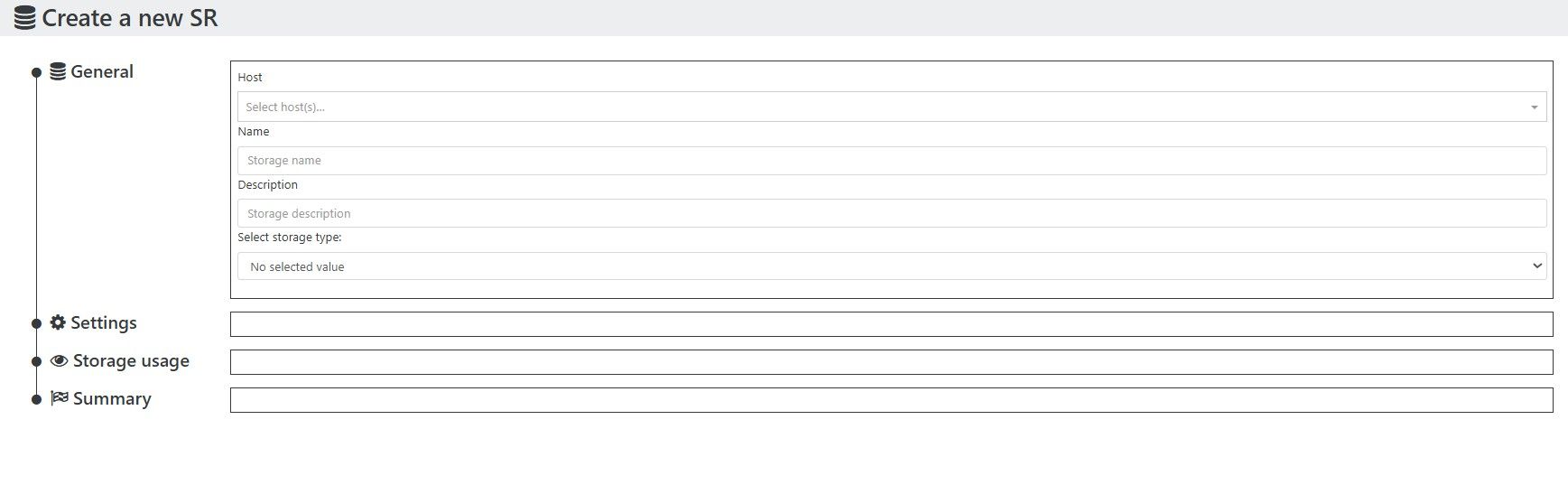
      Slow SR Creation

      Watching Ignoring Scheduled Pinned Locked Moved Unsolved Management
      4
      1
      0 Votes
      4 Posts
      99 Views
      poddingueP
      Thanks for the numbers. So the whole chain drags: 4 to 5 minutes to list the ~90 LUNs, another 1 to 3 to validate one, and the create on top of that. From the XO side I can't tell where that time goes, XO itself, the host's storage layer, or the array answering slowly, and the one measurement that would split it is the host-side probe I mentioned: time xe sr-probe type=lvmoiscsi device-config:target=<ip>, then the same call with device-config:targetIQN=<iqn> added. If the CLI takes just as long, XO is mostly off the hook. A 90-LUN multipath target doesn't sound exotic to me, so probes taking minutes feel worth a proper look, though I honestly don't know what's normal at that scale. @Team-Storage, the numbers above are concrete now, in case it's worth a look on your side.
    • C

      Bringing container visibility back to XO

      Watching Ignoring Scheduled Pinned Locked Moved Xen Orchestra
      4
      1
      0 Votes
      4 Posts
      168 Views
      poddingueP
      No problem about the delay, of course. I put on better glasses, and guess what? There is a Container management section in the XO docs after all, in docs/xo5/manage_infrastructure.md. It doesn't describe the old xscontainer route though. It says you can run Docker inside a VM, then links out to Docker's own docs and the Kubernetes recipe, so there's no procedure sitting there to walk anyone into a wall, and no sign of the feature either. On the features matrix I can't check it the way I checked the rest, because the page builds itself in the browser and fetching it gives me nothing, so treat that one as unchecked rather than confirmed. The Feeder entry still isn't there, I looked again today, so that part stands.
    • J

      Xenserver 6.5 OVF+VHD to XCPNG

      Watching Ignoring Scheduled Pinned Locked Moved Unsolved Migrate to XCP-ng
      4
      0 Votes
      4 Posts
      132 Views
      poddingueP
      Thanks, keep us posted!
    • D

      XCP-ng Windows PV tools announcements

      Watching Ignoring Scheduled Pinned Locked Moved News
      107
      0 Votes
      107 Posts
      34k Views
      C
      @dinhngtu Further trialing showed this issue is confined to one host and all its VMs (including Linux ones) - please consider this issue resolved and not related to Windows PV tools (incidentally, in this particular case there were no verified drivers enabled and no drivers currently verified on the Windows VMs). Apologies for mistaking this as a Windows PV tools issue.
    • P

      Full backups: Why is it not possible to use NBD on full backups ?

      Watching Ignoring Scheduled Pinned Locked Moved Solved Backup
      3
      0 Votes
      3 Posts
      138 Views
      P
      That should be it, tks @poddingue
    • K

      Intermittent Xen blkfront I/O stalls: all guest tags busy while tapdisk reports zero outstanding requests

      Watching Ignoring Scheduled Pinned Locked Moved Unsolved Compute
      13
      0 Votes
      13 Posts
      839 Views
      M
      @anthoineb, We checked both SMlog and xensource.log for the two latest incidents on hypervisor 172.30.50.181. There was no VM or storage pause/unpause operation before either stall. The only matching pause/unpause pairs were part of our later forced VM.hard_reboot: 2026-08-19, VM 172.30.52.185: stall confirmed around 20:24; pause at 20:36:37 and unpause at 20:38:12. 2026-08-20, VM 172.30.52.182: stall confirmed around 20:24; pause at 20:30:07 and unpause at 20:31:26. The first related VDI operations in SMlog were also the vdi_deactivate actions initiated by those reboots. Therefore, we do not see a pause/unpause immediately before or at the onset of either lock.
    • F

      i915 pass-through and Linux Mint - xcp-ng 8.3

      Watching Ignoring Scheduled Pinned Locked Moved Unsolved Compute
      3
      0 Votes
      3 Posts
      137 Views
      TeddyAstieT
      Intel needs some special handling to support physical displays with PCI Passthrough; I don't know much of the details, but on "recent" machines, some bits are missing according to : https://lore.kernel.org/all/20260802050824.10554-1-brchuckz@aol.com/
    • T

      Openmetrics plugin changing Prometheus secret after every xo-server restart

      Watching Ignoring Scheduled Pinned Locked Moved Unsolved Advanced features
      4
      0 Votes
      4 Posts
      224 Views
      T
      @mpiton Thanks for looking into this, I guess it wasn't apparent that I needed to click the Save Configuration button for that plugin. I did that and confirmed that the secret now survives an xo-server restart. Thanks again!
    • M

      Feature request: Change bond mode in XO

      Watching Ignoring Scheduled Pinned Locked Moved Xen Orchestra
      2
      0 Votes
      2 Posts
      61 Views
      poddingueP
      I measured this on a two-NIC 8.3 host. As far as I understand, there's no way to do it from XO: the call that edits a network doesn't take a bond mode, every bondMode in the codebase sits on a create path, and the REST API on a running XOA offers create_bonded_network plus get and delete on a network, with nothing that edits one. The CLI route looks cheap though. xe bond-set-mode on a live bond cost zero dropped packets in both directions I tried, pinging every 200ms across the change, and the command returned in about 1.4 seconds. Two caveats, and the second is about your case specifically: creating and destroying the bond did interrupt the host (roughly 8 and 16 seconds), and I only went active-backup to balance-slb and back, never touching lacp, because my switch port isn't configured as a LAG and I'd have dropped the box. So I can't tell you your lacp to active-backup move is free, only that mode changes in general didn't cost me anything. Worth putting on https://feedback.vates.tech either way so the votes have somewhere to gather.
    • M

      Support for newer Emulex LPe37xxx amd LPe36xxx Fiber channel adapters on XCP-ng 8.3 - your testing is needed

      Watching Ignoring Scheduled Pinned Locked Moved Hardware
      2
      2 Votes
      2 Posts
      49 Views
      poddingueP
      I went digging and three threads turned up people who already have this hardware. @yeopil21 in https://xcp-ng.org/forum/topic/11799 had an LPe37102-D on a Dell R770 that never showed up at all, @jinju0504 in https://xcp-ng.org/forum/topic/11946 ended up on the -alt package on an R670, and @lukas in https://xcp-ng.org/forum/topic/8847 was running an LPe31002-M6-D with NVMe-oF back on 8.3 beta2. That last one is the older generation, so I'd guess it's the side where you most want to hear nothing regressed. Tagging them in case the cards are still on their benches.
    • acebmxerA

      Install XO from sources.

      Watching Ignoring Scheduled Pinned Locked Moved Xen Orchestra
      31
      3 Votes
      31 Posts
      7k Views
      acebmxerA
      v0.4.0 Release - https://github.com/acebmxer/install_xen_orchestra/releases 0.4.0 - 2026-08-23 Changed The cloud image is staged on the pool master by default instead of being streamed. Staging is the only path that can resume a broken download, retry a transient failure, and check the downloaded size before anything reaches the VDI; streaming can do none of those, because a pipe already feeding a fixed-Content-Length PUT cannot be rewound. On a link that drops the occasional TLS record — which any multi-gigabyte transfer eventually meets — streaming failed every attempt while staging rode it out. Streaming is now what it should always have been: the fallback for a host without the few gigabytes of scratch space staging needs. Fixed A stalled streaming import no longer has to be interrupted by hand. When the download end died, the upload sat waiting for a response XAPI would never send. --speed-time could not help — by that point curl is waiting, not transferring, so the speed meter has stopped ticking and only --max-time 3600 would eventually fire. The two transfers now run as separate processes with the download's exit status watched, and the upload is killed the moment it fails. A pool master short on scratch space no longer fails the whole deploy. The staged path signalled "no room" with a plain non-zero return, which under set -e took the script down before the fallback could be reached. A failed cloud-image download no longer looks like a successful import. The streaming import piped one curl into another, and the remote shell reported only the upload side's exit status. A download that died partway — a transient SSL_read ... bad record mac on a 3 GB transfer is the usual cause — therefore produced a truncated disk that the deploy reported as imported, and a VM that booted into a corrupt filesystem. The pipeline now runs under bash -o pipefail. A broken image download no longer hangs the deploy for an hour. When the download end died, the upload curl had already promised XAPI an exact Content-Length and sat waiting to send bytes that were never coming, with XAPI waiting alongside it until --max-time 3600 expired — the visible symptom being a XAPI task frozen at partial progress and a script that had to be interrupted. Both ends now abort after 60s below 1 KiB/s. The staged image download resumes instead of starting over. It now uses -C - with --retry 5 --retry-delay 3 --retry-all-errors, so the transient TLS failures that a multi-gigabyte single-connection download eventually hits are ridden out rather than failing the deploy. The streaming path deliberately does not retry: curl re-issues from byte 0, and piped into a fixed-Content-Length PUT those bytes would be appended to the ones already sent, corrupting the image while appearing to succeed. A short staged download is refused rather than imported. The file's size is now checked against the length the server advertised before anything is written into the VDI. The staged download reports progress. It was silent for several minutes on the longest step of the deploy, which reads as a hang worth killing. A failed deploy names the VM it left behind, with the xe vm-destroy command, instead of leaving a half-built VM to be rediscovered later in the pool's VM list. Nothing is destroyed automatically. --update/--reconfigure/--rebuild no longer abort on a root install. Reading User= from a systemd unit that has no such line (which is what a root install looks like) failed the pipeline under set -o pipefail and took the script down before the fallback could run. Deploy prompts validate values, not just their shape. 999.999.999.999 was accepted as an address and 70000 as a port; both were only rejected after the VM existed, by an unreachable guest or by the installer inside it. Prompted settings are no longer lost when the base config omits the key. The generated xo-config.cfg was patched with sed, which silently does nothing for a key that is not there — so the VM installed on the default while the summary showed the value you typed. Missing keys are now appended. An $EDITOR with arguments works. code --wait passed the availability check and then failed with "No such file", since the whole string was treated as one executable path. Values edited into the config are validated. An unusable port or branch was silently ignored, leaving the summary showing one thing and the VM installing another. Troubleshooting commands point at a key that still exists. The ssh -i lines printed on a failed install and on a non-200 health check named the temporary key, which the exit trap had already deleted. A second VM with the same hostname no longer overwrites the first one's SSH key, which was the only way into that machine. The disk-space check before staging an image on the pool master is derived from the image's actual size instead of a hard-coded 4 GiB, which rejected small images and let large ones fill /var/tmp mid-download. tests/probe-xapi-deploy.sh acquires its XAPI session from the pool master, the way --deploy does, so a firewall that blocks port 443 from your workstation no longer skips the HTTP transport probes that matter. It also validates --host, --user, --sr, --image and --payload-mb before they reach a shell, drops the eval in the workstation-side transport, and exits non-zero when any probe failed rather than whenever one transport worked. The menu example in the README and the layout comment above MENU_NAMES described the old fixed 5/4/centered grid; with ten items the menu draws five entries in each column. Security The cloud image is verified against its published checksum. The size check catches a download that was cut short; it cannot catch one that arrived complete from the wrong place, because a substituted image has a perfectly consistent Content-Length. The staged image is now checked against the SHA512SUMS its origin publishes beside it — which is what Debian ships — and a mismatch aborts before anything reaches the disk. An origin that publishes no sums warns and continues, so a custom XO_DEPLOY_IMAGE_URL keeps working. Set XO_DEPLOY_IMAGE_SHA512 to require a specific digest instead: that makes the check mandatory, aborting rather than continuing unverified, and refuses the streaming import outright because a pipe fed straight into the VDI leaves no file to hash. Fetching sums over the same connection as the image is not a detached signature — it defends against a bad mirror or a stale cache, not an attacker holding the TLS session for both requests. A pinned pool-master fingerprint is now enforced instead of advised. deploy_verify_host_key fingerprinted the host key and then returned success on every path that could not complete the check — so with XO_DEPLOY_POOL_FINGERPRINT set, a ssh-keyscan that timed out meant the host password was sent to whatever answered on that address, which is exactly what pinning exists to prevent and the easiest outcome for an on-path attacker to arrange. A pin that cannot be checked is now a hard failure. The verified host key is bound to the connection that carries the password. The scanned key was fingerprinted, shown, and then discarded, while dom0_exec connected with StrictHostKeyChecking=accept-new against the default known_hosts — verifying one transaction and trusting another. Nothing stopped a different key, or the host's RSA key when the ED25519 one had been displayed, being accepted at connect time. The whole scan is now pinned into a run-scoped known_hosts that dom0_exec enforces with StrictHostKeyChecking=yes, the same way deploy_wait_for_guest already treated the guest. A hostile pool master can no longer run commands on the workstation. The free-space probe in deploy_import_vdi_staged fed the host's reply straight into (( )), which expands an array subscript before evaluating it — so an answer of PATH[$(...)] executed locally rather than being rejected. It is now checked against ^[0-9]+$ first, matching the guards already applied to size and got in the same function. Note that set -euo pipefail does not cover this: set -u blocks only the unbound-variable form of the payload. This mattered more after staging became the default import path, because the probe went from rarely reached to running on every deploy. The pool master's root password is no longer visible in ps. Three calls predating dom0_exec still used sshpass -p "$HOST_PASSWORD", putting the password in the process list where any other user on the workstation could read it. They now use sshpass -e with $SSHPASS, as dom0_exec does. The admin password hash is kept out of XO_DEBUG=1 output. deploy_harden_guest_sudo and deploy_build_config_drive were missing the local - / set +x guard the rest of the script uses, so the hash was printed by xtrace. Previously masked on automated runs only because --non-interactive left the hash empty; requiring a password made it reachable on every deploy. Revoking the deployment key can no longer empty authorized_keys. A grep failure — no space for the temporary file, an unreadable source — was swallowed by || true and the empty result written back, taking the operator's own key with it. grep's "nothing matched" (a legitimate empty result) is now distinguished from a real error, which aborts and leaves the file untouched. The streaming import's FIFO is created inside a private directory. mktemp -u returns a name without creating anything, leaving a window in dom0's world-writable /tmp. The FIFO now lives in a mktemp -d directory. DSA public keys are rejected. ssh-dss was accepted by deploy_load_pubkey, but OpenSSH has refused DSA since 7.0 and removed it in 9.8, so it only installed a key that silently never worked. The cloud-init cache scrub covers cloud-config.txt. The rendered config holds hashed_passwd just as the raw user-data does; only the latter was being redacted. The deployment SSH key is destroyed at the end of a deploy. It used to be...
    • B

      Native Ceph RBD SM driver for XCP-ng

      Watching Ignoring Scheduled Pinned Locked Moved Development
      24
      3 Votes
      24 Posts
      6k Views
      olivierlambertO
      Nice! Have you tested the snapshot, revert and so on?